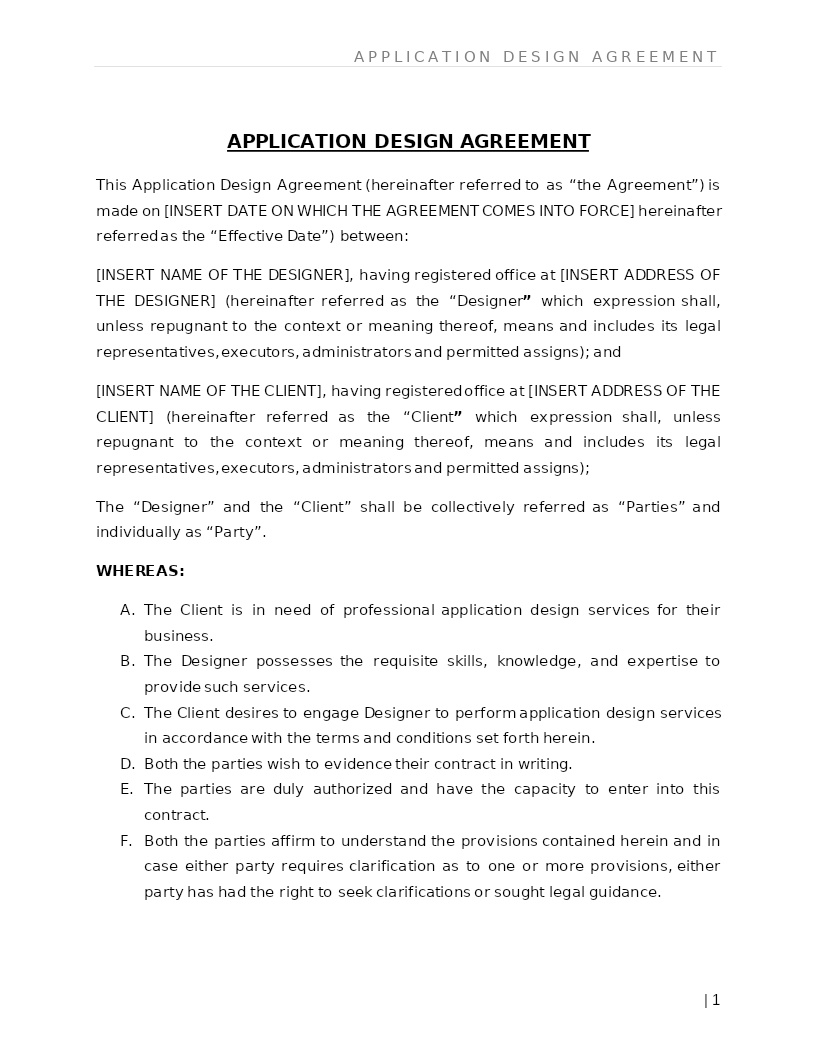
APPLICATION DESIGN AGREEMENT
How does it work?
1. Choose this template
Start by clicking on "Fill out the template"
2. Complete the document
Answer a few questions and your document is created automatically.
3. Save - Print
Your document is ready! You will receive it in Word and PDF formats. You will be able to modify it.
Application Design Agreement – Draft Format
“Who owns the design once the application is completed?”
“What happens if the project scope changes midway?”
“Are design files and assets automatically transferred to the client?”
“What if there is a dispute over revisions, payments, or delivery timelines?”
Application design projects often begin with creative collaboration and clear intentions. Disputes may arise later regarding ownership of design assets, scope changes, payment milestones, intellectual property rights, or expectations that were not clearly documented at the outset.
An Application Design Agreement exists to reduce that uncertainty.
This Application Design Agreement template provides a structured legal framework for documenting the terms under which a designer, design studio, or agency provides application design services to a client. It addresses issues such as project scope, design deliverables, revision processes, payment terms, intellectual property ownership, confidentiality obligations, and project timelines.
The template is drafted in line with generally accepted contract and intellectual property principles across multiple jurisdictions. It is designed to be adapted to applicable governing law and the specific needs of a design project.
It is not a substitute for legal advice in complex situations. It is intended as a practical starting point for documenting application design engagements responsibly.
Quick Legal Summary (At a Glance)
• Application design agreements are legally binding contracts when properly drafted and executed.
• This template provides a structured framework for defining design services and deliverables.
• Enforceability depends on applicable contract law, copyright regulations, and governing law provisions.
• Intellectual property ownership should be clearly defined to avoid disputes over design assets.
• For high-value commercial projects, cross-border work, or complex intellectual property structures, legal review may be advisable.
This summary is provided for general informational purposes and does not constitute legal advice.
What Is an Application Design Agreement and When Do You Need One?
An Application Design Agreement is a legally binding contract between a client and a designer (or design agency) that defines the terms under which design services for a mobile or web application will be provided.
The agreement typically clarifies the scope of design work, timelines, revision limits, payment structure, intellectual property ownership, and other project expectations.
You may need a formal Application Design Agreement when:
• Commissioning UI or UX design for a mobile or web application
• Hiring freelance designers or design studios for application interfaces
• Developing wireframes, prototypes, or user journey maps
• Outsourcing design work during application development
• Protecting proprietary design concepts or branding elements
• Structuring milestone-based design deliverables and payments
A well-structured application design agreement generally defines:
• Scope of design services
• Deliverables and design assets
• Milestones and timelines
• Revision policies
• Payment terms and schedules
• Intellectual property ownership
• Confidentiality obligations
• Termination and dispute resolution provisions
Clear documentation reduces misunderstandings and helps align expectations between designers and clients.
Types of Application Design Arrangements
This template can be adapted for different design engagement structures, depending on the nature of the project.
- UI/UX Design Engagement: Used when designers are responsible for user interface layouts, user journeys, and experience design.
- Mobile Application Design Engagement: Applies to the design of mobile applications for platforms such as iOS or Android.
- Web Application Design Engagement: Used for SaaS platforms, dashboards, web portals, and responsive application interfaces.
- Wireframe and Prototype Design Engagement: Suitable for early-stage product development where conceptual layouts and interactive prototypes are created.
- Brand-Integrated Application Design Engagement: Used when the application design must align closely with an organization’s brand identity, style guides, and design systems.
Each arrangement may require modifications depending on project complexity and governing law.
Are Application Design Agreements Legally Enforceable Internationally?
Application design agreements are commonly recognised under contract law and intellectual property frameworks in many jurisdictions. Their enforceability typically depends on factors such as:
• Lawful purpose
• Clear definition of deliverables
• Valid contractual consent
• Proper identification of intellectual property ownership
• Compliance with applicable copyright and commercial laws
Legal frameworks differ across jurisdictions. For example:
United States: Design agreements are generally governed by contract law and copyright protections under the Copyright Act.
United Kingdom and European Union: Intellectual property rights and contractual obligations are governed by commercial law frameworks and copyright legislation.
United Arab Emirates and Saudi Arabia: Digital design agreements may be enforced under civil and commercial law systems with modern intellectual property protections.
Australia and Canada: Copyright legislation and contract law govern ownership and licensing of creative works.
India and Southeast Asia: Design ownership and contractual rights are typically governed by contract law and copyright statutes.
Courts generally evaluate these agreements based on clarity of terms, fairness, and compliance with applicable law.
Considerations in Complex Application Design Projects
Generic design contracts may omit important safeguards relevant to digital product development.
In more complex application design engagements, additional considerations may include:
Intellectual Property Ownership: Clarifying whether ownership of final design assets transfers to the client or remains licensed to the client.
Scope and Deliverables: Defining exactly what deliverables are included, such as wireframes, prototypes, design systems, or final visual assets.
Revision and Feedback Processes: Setting limits on revisions to avoid scope expansion beyond the original agreement.
Payment and Milestones: Establishing structured payment stages linked to project progress.
Confidentiality and Pre-Release Protection: Protecting proprietary application concepts and design elements.
Source File Delivery: Clarifying whether layered design files or editable source files will be provided to the client.
Clear contractual structure helps reduce ambiguity and support smooth project execution.
When This Application Design Agreement Template May Not Be Sufficient
A template may require further modification if:
• The design work involves multiple jurisdictions
• The project includes substantial intellectual property creation
• Regulatory or data protection considerations are involved
• The project forms part of a larger software development contract
• The commercial value of the project is significant
Additional contractual provisions may be necessary depending on the legal and commercial context.
Common Mistakes in Application Design Agreements
Many design-related disputes arise from avoidable drafting or implementation issues, such as:
• Failing to clearly define project scope
• Not specifying ownership of design assets
• Lack of revision limits or feedback timelines
• Unclear milestone payment structures
• Ambiguous termination provisions
• Copying clauses from unrelated service agreements
Understanding these risks may help ensure responsible and effective documentation of design engagements.
Who Should Use This Application Design Agreement Template?
This template is commonly used by:
• Freelance UI/UX designers
• Design studios and digital agencies
• Startups commissioning application design work
• Businesses redesigning an existing application interface
• App development firms outsourcing design services
It provides a structured starting point for documenting application design relationships clearly.
How to Use This Application Design Agreement Template Safely
Step-by-Step
- Enter the legal details of the client and the designer or agency.
- Clearly define the scope of design services and project deliverables.
- Establish milestones, revision limits, and project timelines.
- Specify payment structure and milestone payments.
- Clarify ownership or licensing of intellectual property rights.
- Include confidentiality provisions where appropriate.
- Select governing law consistent with the applicable jurisdiction.
- Execute the agreement through valid electronic or physical signature.
Electronic signatures are generally recognised in many jurisdictions, subject to applicable law and consent requirements.
Frequently Asked Questions (FAQs)
Is this Application Design Agreement valid internationally?
It provides a general contractual structure that may be adapted across jurisdictions. Enforceability depends on compliance with applicable law.
Does the agreement cover both mobile and web application design?
Yes. The template can be adapted for both mobile and web-based applications.
Does the agreement define ownership of design assets?
Yes. It includes provisions addressing ownership or licensing of final design deliverables.
Can milestone-based payments be included?
Yes. Payment terms may be structured according to project phases or deliverables.
Does the agreement include confidentiality provisions?
Yes. Confidential information and proprietary design concepts may be protected through confidentiality clauses.
Can designers display the project in their portfolio?
This may be permitted if the agreement includes appropriate provisions allowing portfolio use.
Does the agreement address project termination?
Yes. It includes provisions for termination and payment for work completed prior to termination.
Download the Application Design Agreement Template
This Application Design Agreement template provides a structured framework for documenting the terms of application design projects.
It is designed to promote clarity in project expectations, protect intellectual property interests, and support responsible documentation of creative and commercial relationships.
Important Notice
This template is provided as a general informational resource and does not constitute legal advice, solicitation, or advertisement within the meaning of the Bar Council of India Rules.
Use of this template does not create an advocate-client relationship.
Users should ensure the final agreement complies with applicable laws and project requirements
.
Related Templates You May Need
• Software Development Agreement
• Brand Identity and Graphic Design Agreement
• Intellectual Property Assignment Agreement
• Non-Disclosure Agreement (NDA)
