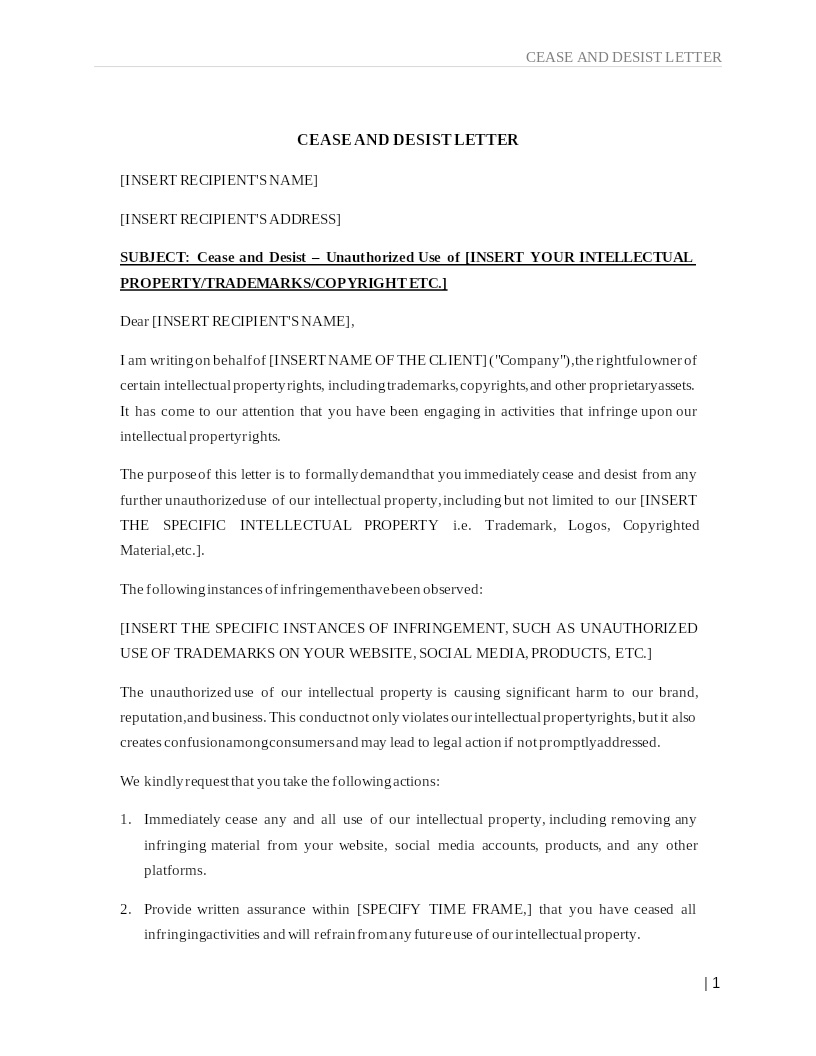
CEASE AND DESIST LETTER
How does it work?
1. Choose this template
Start by clicking on "Fill out the template"
2. Complete the document
Answer a few questions and your document is created automatically.
3. Save - Print
Your document is ready! You will receive it in Word and PDF formats. You will be able to modify it.
Cease and Desist Letter – Draft Format
“Someone is using my content or brand without permission. What can I do?”
“How can I formally demand that harmful behavior stops?”
“Is there a way to resolve the issue before filing a lawsuit?”
“What is the proper way to warn someone about legal consequences?”
Disputes involving intellectual property misuse, defamation, harassment, contractual breaches, or unfair practices often begin with informal complaints or misunderstandings. When such conduct continues, a formal written notice may become necessary to communicate the seriousness of the issue and request immediate corrective action.
A Cease and Desist Letter exists to address that situation.
This Cease and Desist Letter template provides a structured framework for formally notifying an individual or organisation that certain conduct must stop. It typically identifies the alleged violation, explains the legal or contractual basis of the claim, and requests the recipient to discontinue the specified conduct within a defined period.
The template is drafted with reference to commonly recognised legal principles governing civil disputes across multiple jurisdictions. It is designed to serve as an initial step in resolving disputes without immediately initiating litigation.
It is not a substitute for legal advice in complex matters. It is intended as a practical starting point for communicating legal concerns in a structured and responsible manner.
Quick Legal Summary (At a Glance)
• A Cease and Desist Letter is a formal legal notice requesting that certain actions stop.
• It is often used as an early step before initiating legal proceedings.
• The letter identifies the alleged violation and requests corrective action within a specified time.
• Sending such a letter may demonstrate that the sender attempted to resolve the matter before litigation.
• Enforceability and legal consequences depend on applicable laws and the specific circumstances involved.
This summary is provided for general informational purposes and does not constitute legal advice.
What Is a Cease and Desist Letter and When Do You Need One?
A Cease and Desist Letter is a formal written notice sent by an individual or organisation to another party demanding that certain conduct stop immediately. It typically outlines the nature of the alleged violation and warns that legal action may follow if the behaviour continues.
Such letters are commonly used when a party believes that their legal rights, reputation, intellectual property, or contractual interests have been violated.
You may need a Cease and Desist Letter when:
• Intellectual property such as trademarks, copyrights, or designs are being used without permission
• False or defamatory statements are being published or circulated
• Harassment, threats, or abusive communications are occurring
• Confidential information or trade secrets are being misused
• Contractual obligations are being breached
• Unfair or misleading commercial practices are occurring
A well-structured Cease and Desist Letter generally includes:
• Identification of the sender and recipient
• Description of the alleged unlawful or harmful conduct
• Explanation of the legal or contractual rights involved
• Request for the recipient to stop the conduct immediately
• A reasonable timeframe for compliance
• Notice of possible legal action if the issue is not resolved
Clear documentation may assist in communicating concerns formally while allowing the recipient an opportunity to rectify the situation.
Types of Cease and Desist Notices
This template can be adapted to different situations depending on the nature of the dispute.
- Intellectual Property Cease and Desist Letter: Used to address unauthorized use of trademarks, copyrighted works, designs, or proprietary materials.
- Defamation Cease and Desist Letter: Used when false statements are being published or circulated that may harm an individual’s or organisation’s reputation.
- Harassment Cease and Desist Letter: Used to request that an individual stop unwanted or threatening behaviour.
- Contractual Breach Notice: Used when a party is violating obligations under an agreement.
- Online Content Removal Notice: Used to demand removal of unlawful or infringing content from websites, platforms, or social media.
Each type of notice may require adjustments depending on applicable law and the factual circumstances of the dispute.
Are Cease and Desist Letters Legally Recognised Internationally?
Cease and Desist Letters are commonly used across legal systems as a pre-litigation communication tool. While the letter itself does not constitute a court order, it may serve as evidence that the sender attempted to resolve the dispute before initiating legal proceedings.
Recognition and use of such notices exist in many jurisdictions. For example:
United States: Cease and desist letters are commonly used in intellectual property and civil disputes as a pre-litigation notice.
United Kingdom and European Union: Legal notices are frequently used to request compliance before initiating civil proceedings.
United Arab Emirates and Saudi Arabia: Formal notices may be used to communicate contractual or commercial disputes before litigation.
Australia and Canada: Pre-action notices are often encouraged to allow parties an opportunity to resolve disputes outside court.
India and Southeast Asia: Legal notices are widely used to demand corrective action before filing civil claims.
Courts may consider such notices when evaluating whether reasonable attempts were made to resolve the dispute prior to litigation.
Considerations in Complex Dispute Situations
Generic notices may not address all relevant legal issues in more complex disputes.
Important considerations may include:
Accurate Identification of Violations: Clearly describing the conduct that allegedly violates legal rights.
Evidence and Documentation: Supporting the claim with relevant facts, dates, or documentation.
Appropriate Legal Basis: Referencing applicable legal rights or contractual provisions where relevant.
Proportional Demands: Ensuring the request for compliance is reasonable and clearly defined.
Careful Language: Avoiding defamatory or misleading statements while presenting the claim.
A carefully structured notice may help encourage compliance and reduce the risk of escalating the dispute unnecessarily.
When This Cease and Desist Letter Template May Not Be Sufficient
A template may require modification if:
• The dispute involves complex intellectual property rights
• The matter involves multiple jurisdictions
• Significant financial damages are involved
• Regulatory or criminal implications may arise
• Litigation has already been initiated
In such circumstances, professional legal advice may be appropriate.
Common Mistakes in Cease and Desist Letters
Disputes sometimes escalate due to poorly drafted notices, including:
• Making unsupported or exaggerated legal claims
• Using threatening or inflammatory language
• Failing to clearly describe the alleged violation
• Omitting deadlines for compliance
• Sending notices without verifying factual accuracy
• Copying templates that do not apply to the situation
Responsible drafting improves the effectiveness and credibility of the communication.
Who Should Use This Cease and Desist Letter Template?
This template may be useful for:
• Businesses protecting trademarks, copyrights, or proprietary content
• Individuals responding to defamatory statements or online misuse
• Organisations seeking to stop contractual violations
• Companies addressing unfair commercial practices
• Rights holders requesting removal of unauthorized content
It serves as a structured starting point for formally communicating legal concerns.
How to Use This Cease and Desist Letter Template Safely
Step-by-Step
- Identify the sender and the recipient clearly.
- Describe the conduct that is alleged to violate legal rights.
- Provide relevant factual details or supporting evidence.
- Request that the recipient stop the specified conduct immediately.
- Provide a reasonable deadline for compliance.
- Indicate that legal action may be considered if the issue is not resolved.
- Send the notice through an appropriate communication method such as registered post, email, or legal service.
Proper documentation of the notice may be useful if further legal steps become necessary.
Frequently Asked Questions (FAQs)
Is a Cease and Desist Letter legally binding?
The letter itself is not a court order. However, it serves as a formal notice that may precede legal action.
Is sending a cease and desist letter mandatory before filing a lawsuit?
Not always. However, providing prior notice may help demonstrate that reasonable efforts were made to resolve the issue.
Can individuals send a cease and desist letter?
Yes. Both individuals and organisations may send such notices when they believe their rights are being violated.
What happens if the recipient ignores the letter?
The sender may consider further legal remedies depending on the circumstances and applicable law.
Can this letter be used for online disputes?
Yes. Cease and desist notices are frequently used to address online infringement, defamation, or unauthorized content.
Download the Cease and Desist Letter Template
This Cease and Desist Letter template provides a structured framework for formally notifying another party to stop conduct that may violate legal rights.
It is designed to support clear communication and provide an opportunity for dispute resolution before escalating the matter to litigation.
Important Notice
This template is provided as a general informational resource and does not constitute legal advice, solicitation, or advertisement within the meaning of the Bar Council of India Rules.
Use of this template does not create an advocate–client relationship.
Users should ensure the document is adapted to the facts of the situation and applicable law.
Related Templates You May Need
• Non-Disclosure Agreement (NDA)
• Intellectual Property Assignment Agreement
• Trademark License Agreement
• Defamation Legal Notice Template
