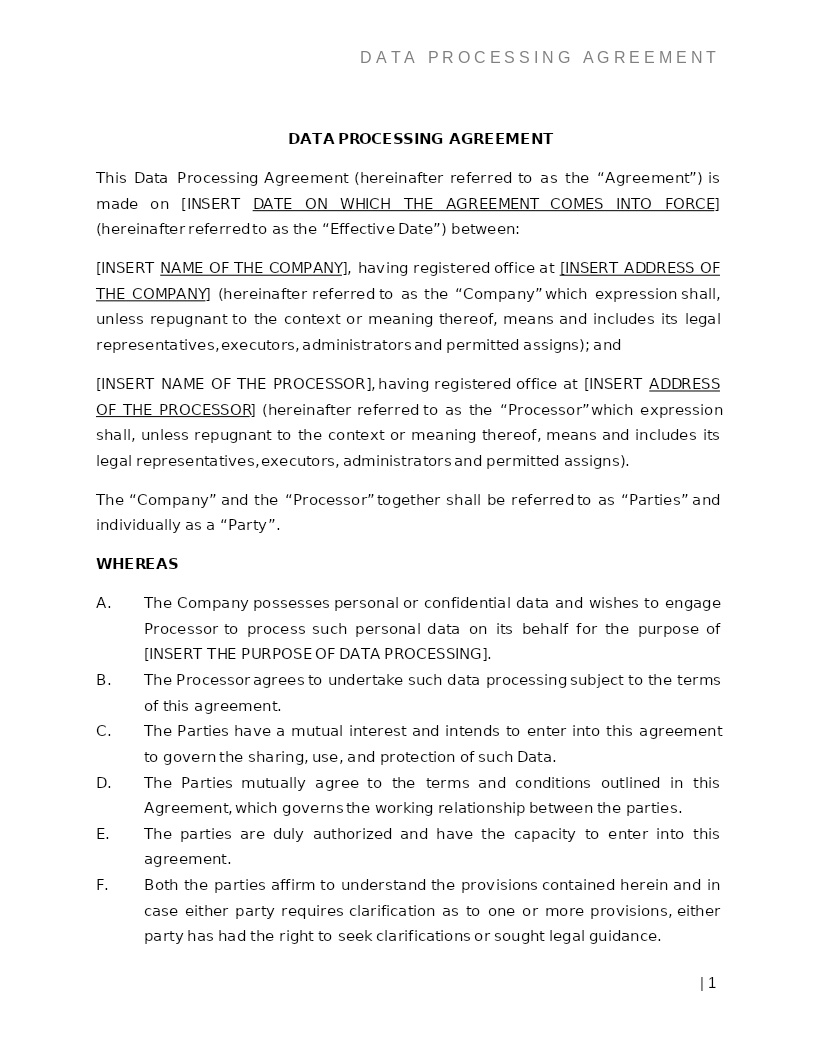
DATA PROCESSING AGREEMENT
How does it work?
1. Choose this template
Start by clicking on "Fill out the template"
2. Complete the document
Answer a few questions and your document is created automatically.
3. Save - Print
Your document is ready! You will receive it in Word and PDF formats. You will be able to modify it.
Data Processing Agreement – Draft Format
“Do we need a separate agreement when another company processes our data?”
“What responsibilities does a vendor have when handling personal data?”
“How are cross-border transfers or security obligations documented?”
“What happens if there is a data breach or misuse of personal data?”
Businesses increasingly rely on external service providers to process, store, analyse, or manage personal data. While such arrangements enable operational efficiency, disputes and regulatory issues can arise when responsibilities for data protection, security, and regulatory compliance are not clearly defined.
A Data Processing Agreement exists to reduce that uncertainty.
This Data Processing Agreement (DPA) template provides a structured legal framework for documenting the relationship between a Data Controller and a Data Processor when personal data is processed on behalf of an organization. It addresses responsibilities relating to data security, confidentiality, regulatory compliance, cross-border transfers, breach notification, and data deletion or return.
The template is drafted with reference to widely recognised privacy law principles and regulatory frameworks across multiple jurisdictions. It is designed to be adapted to applicable governing law and the specific data processing activities involved.
It is not a substitute for legal advice in complex regulatory environments. It is intended as a practical starting point for documenting data processing relationships responsibly.
Quick Legal Summary (At a Glance)
• Data Processing Agreements are commonly required when personal data is processed by a third party.
• Many privacy frameworks, including the General Data Protection Regulation (GDPR), require controllers to enter into written agreements with processors.
• This template provides a structured framework for defining data protection obligations and processing responsibilities.
• Enforceability depends on compliance with applicable privacy laws and contractual requirements.
• For cross-border transfers, large-scale processing, or sensitive data categories, additional regulatory review may be advisable.
This summary is provided for general informational purposes and does not constitute legal advice.
What Is a Data Processing Agreement and When Do You Need One?
A Data Processing Agreement is a legally binding contract between a Data Controller (the organization that determines the purpose and means of processing personal data) and a Data Processor (the entity that processes personal data on behalf of the controller).
The agreement defines how personal data will be handled, protected, and processed in accordance with applicable data protection laws.
You typically need a Data Processing Agreement when:
• Outsourcing data processing to a vendor or service provider
• Using cloud storage, analytics platforms, or CRM tools
• Engaging customer support or marketing service providers that access user data
• Sharing personal data with external software providers
• Transferring personal data internationally
• Handling sensitive or regulated categories of personal information
A well-structured Data Processing Agreement generally defines:
• Nature and purpose of data processing
• Categories of personal data involved
• Roles and responsibilities of the parties
• Technical and organizational security measures
• Confidentiality obligations
• Subprocessor approval requirements
• Data breach notification procedures
• Data retention and deletion obligations
• Audit and compliance rights
Clear documentation supports accountability and helps organisations demonstrate compliance with privacy regulations.
Types of Data Processing Arrangements
This template can be adapted to different types of data processing relationships depending on the structure of the data handling arrangement.
Controller-to-Processor Arrangement: Used when a business engages a vendor or service provider to process personal data on its behalf.
Processor-to-Subprocessor Arrangement: Applies when a processor delegates certain processing activities to another service provider.
Joint Controller Arrangement: Used when two or more organisations jointly determine the purposes and means of processing personal data.
Cross-Border Data Processing Arrangement: Relevant when personal data is transferred across jurisdictions, often requiring additional safeguards such as standard contractual clauses.
Each structure may require jurisdiction-specific adjustments depending on the applicable data protection laws.
Are Data Processing Agreements Legally Enforceable Internationally?
Data Processing Agreements are widely recognised under modern privacy and data protection frameworks. Their enforceability typically depends on factors such as:
• Compliance with applicable privacy legislation
• Clear definition of processing activities
• Adequate security and confidentiality obligations
• Proper allocation of responsibilities between controller and processor
Data protection laws differ across jurisdictions. For example:
United States: Several state privacy laws, including those governing consumer privacy rights, require contractual safeguards when personal data is processed by third parties.
United Kingdom and European Union: The General Data Protection Regulation (GDPR) requires controllers to enter into written agreements with processors outlining processing obligations.
United Arab Emirates and Saudi Arabia: Modern data protection frameworks require contractual safeguards for data handling and cross-border transfers.
Australia and Canada: Privacy laws regulate how organisations transfer and safeguard personal information when outsourcing data processing.
India and Southeast Asia: Data protection and information technology regulations increasingly emphasise contractual safeguards for personal data handling.
Courts and regulatory authorities typically assess DPAs based on regulatory compliance, clarity of responsibilities, and adequacy of security measures.
Considerations in Complex Data Processing Arrangements
Generic templates may not address the full scope of obligations in complex data processing environments.
In more sophisticated processing arrangements, additional considerations may include:
Data Security Measures: Clear documentation of encryption, access controls, monitoring systems, and other technical safeguards.
Cross-Border Data Transfers: Compliance with legal frameworks governing international data transfers.
Sensitive Data Categories: Additional safeguards when processing financial, biometric, health, or other sensitive personal data.
Subprocessor Management: Controls over whether and how subprocessors may be engaged.
Breach Notification Procedures: Defined processes for reporting and responding to data breaches.
Audit and Compliance Mechanisms: Provisions allowing controllers to verify that processors comply with contractual obligations.
Structured agreements can assist organisations in managing regulatory risk and maintaining responsible data governance practices.
When This Data Processing Agreement Template May Not Be Sufficient
A template may require further modification if:
• Processing activities involve multiple jurisdictions with differing regulatory frameworks
• Large-scale personal data processing is involved
• Highly sensitive categories of personal data are handled
• Regulatory approvals or sector-specific compliance requirements apply
• Complex data-sharing arrangements exist between multiple parties
In such cases, additional regulatory or legal review may be appropriate.
Common Mistakes in Data Processing Agreements
Many privacy compliance issues arise from avoidable drafting or implementation errors, such as:
• Failing to clearly define controller and processor roles
• Omitting required regulatory provisions
• Insufficient documentation of security safeguards
• Lack of clear breach notification procedures
• Ignoring cross-border transfer requirements
• Copying clauses that do not align with actual processing practices
Understanding these risks may help organisations use data processing agreements more responsibly.
Who Should Use This Data Processing Agreement Template?
This template is commonly used by:
• SaaS providers processing customer data
• Businesses outsourcing data storage or analytics services
• Companies using cloud platforms or CRM systems
• Organisations engaging third-party vendors with access to personal data
• Technology companies and digital service providers
It provides a structured starting point for documenting data processing relationships clearly.
How to Use This Data Processing Agreement Template Safely
Step-by-Step
- Identify the parties involved and define their roles as controller or processor.
- Specify the categories of personal data being processed.
- Describe the purpose and scope of processing activities.
- Document the security measures applied to protect personal data.
- Establish breach notification procedures and timelines.
- Address cross-border transfer requirements where applicable.
- Select governing law consistent with applicable jurisdiction.
- Execute the agreement through valid electronic or physical signature.
Electronic signatures are recognised in many jurisdictions, subject to applicable law and consent requirements.
Frequently Asked Questions (FAQs)
Is this Data Processing Agreement valid internationally?
It provides a general structure that may be adapted across jurisdictions. Enforceability depends on compliance with applicable privacy laws.
Who needs a Data Processing Agreement?
Any organisation that engages a third party to process personal data on its behalf may require a DPA.
Does this template support GDPR requirements?
The structure reflects widely recognised data protection principles, including those commonly required under GDPR frameworks.
Can the processor appoint subprocessors?
This depends on the terms of the agreement and whether the controller grants approval.
Does the agreement include breach notification obligations?
Yes. It can specify procedures and timelines for notifying the controller of data breaches.
Does the agreement address data retention and deletion?
Yes. It may include provisions governing how data is stored, returned, or deleted.
Download the Data Processing Agreement Template
This Data Processing Agreement template provides a structured framework for documenting data processing arrangements and responsibilities.
It is designed to promote transparency, accountability, and responsible handling of
personal data when adapted to applicable law.
Important Notice
This template is provided as a general informational resource and does not constitute legal advice, solicitation, or advertisement within the meaning of the Bar Council of India Rules.
Use of this template does not create an advocate–client relationship.
Users should ensure the final agreement complies with applicable data protection laws and regulatory requirements.
Related Templates You May Need
• Data Sharing Agreement
• Privacy Policy
• Information Security Policy
• Non-Disclosure Agreement (NDA)
