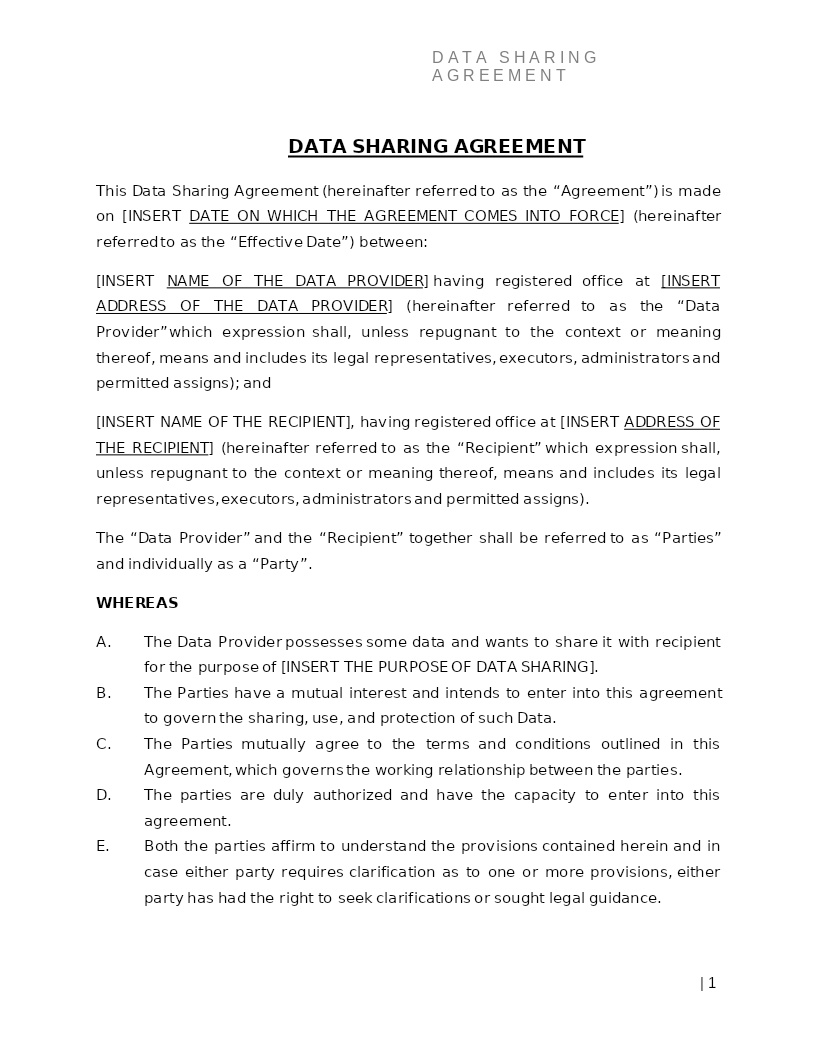
DATA SHARING AGREEMENT
How does it work?
1. Choose this template
Start by clicking on "Fill out the template"
2. Complete the document
Answer a few questions and your document is created automatically.
3. Save - Print
Your document is ready! You will receive it in Word and PDF formats. You will be able to modify it.
Data Sharing Agreement – Draft Format
“Is sharing this data legally permitted?”
“What happens if the other party mishandles the data?”
“Do privacy laws require a formal agreement?”
“Can a simple email approval protect us legally?”
Data collaborations often begin with operational convenience. Legal and compliance concerns usually arise later, particularly when questions surface about data ownership, privacy obligations, regulatory compliance, or responsibility following a security incident.
A Data Sharing Agreement exists to reduce that uncertainty.
This Data Sharing Agreement template provides a structured legal framework for documenting how data may be exchanged, accessed, processed, protected, and retained between parties. It is drafted in line with commonly recognised data protection and privacy governance principles and is designed to be adapted to the governing law and applicable regulatory framework.
It is not a substitute for legal advice in complex regulatory or cross-border data environments. It is intended as a structured starting point.
Quick Legal Summary (At a Glance)
- Data sharing arrangements may create legal obligations under privacy and data protection laws.
- A Data Sharing Agreement helps define responsibilities for handling shared data.
- Compliance obligations may arise under laws such as GDPR, CCPA, and other data protection regulations.
- Data sharing agreements cannot override mandatory statutory privacy protections.
- Cross-border transfers, sensitive data categories, or regulated industries may require additional legal safeguards.
This summary is provided for general informational purposes only and does not constitute legal advice.
What Is a Data Sharing Agreement and When Do You Need One?
A Data Sharing Agreement is a legally binding contract between two or more parties that governs the exchange, use, protection, and management of data.
You typically need a Data Sharing Agreement when:
- Two organisations exchange customer, employee, or operational data
- Businesses collaborate on analytics, research, or technology integrations
- Platforms share user data with service providers or partners
- Organisations transfer regulated or sensitive information
- Joint projects require shared access to databases or datasets
- Data protection laws require clearly defined responsibilities between parties
A well-structured data sharing agreement generally defines:
- Categories of data being shared
- Lawful purpose for data sharing
- Data protection and security requirements
- Roles and responsibilities of each party
- Access limitations and usage restrictions
- Data retention and deletion policies
- Incident reporting and breach notification obligations
- Governing law and dispute resolution
Clear documentation promotes transparency, accountability, and regulatory compliance.
Types of Data Sharing Arrangements
Data sharing agreements can support multiple operational models depending on the nature of collaboration and regulatory obligations.
1. Operational Data Sharing: Used when businesses exchange operational information such as customer records, service usage data, or transactional datasets.
2. Research and Analytics Collaboration: Common in academic, healthcare, or technology partnerships where datasets are shared for statistical analysis or research purposes.
3. Platform or API Data Integration: Frequently used when software platforms exchange data through system integrations or APIs.
4. Regulatory or Compliance Data Transfers: Occurs when organisations must provide data to partners, regulators, or authorised entities under statutory obligations.
Each arrangement may require jurisdiction-specific modifications to ensure regulatory compliance.
Are Data Sharing Agreements Legally Enforceable Internationally?
Data sharing agreements are widely recognised under contract law and data protection frameworks, but enforceability depends on several factors:
- Lawful purpose for the data transfer
- Compliance with applicable privacy laws
- Clear allocation of responsibilities
- Adequate security safeguards
- Valid governing law and jurisdiction clauses
Privacy laws vary significantly across jurisdictions. For example:
- European Union: Data sharing must comply with the General Data Protection Regulation (GDPR).
- United States: State-level frameworks such as the California Consumer Privacy Act (CCPA) may apply.
- United Kingdom: UK GDPR and Data Protection Act requirements apply.
- India: Data protection obligations may arise under evolving privacy regulations and sector-specific frameworks.
- Other jurisdictions: Local data protection authorities may impose additional compliance obligations.
Courts and regulators generally assess data sharing arrangements based on lawfulness, transparency, and data protection safeguards. No template guarantees universal enforceability.
Considerations in Complex Data Sharing Arrangements
Generic templates often overlook important regulatory or operational safeguards.
In more complex environments, additional provisions may be necessary depending on the context.
- Clear Purpose Limitation: Defines the legitimate purpose for which shared data may be used.
- Security and Safeguards: Addresses encryption, access controls, and technical security practices.
- Sensitive Data Handling: May include additional protections for health information, financial data, or personal identifiers.
- Breach Notification Procedures: Establishes responsibilities and timelines for reporting security incidents.
- Cross-Border Transfer Mechanisms: May be necessary when data moves across international jurisdictions.
Well-structured documentation may help reduce legal uncertainty and improve accountability.
When This Data Sharing Agreement Template May Not Be Sufficient
A standard template may not be adequate if:
- The data includes highly sensitive personal information
- Multiple jurisdictions regulate the data transfer
- The project involves regulated industries (e.g., healthcare or finance)
- The arrangement includes large-scale analytics or AI processing
- The parties operate under strict regulatory oversight
In such cases, legal review may be necessary to ensure compliance with applicable regulations.
Common Mistakes in Data Sharing Agreements
Many data governance issues arise from preventable drafting or implementation errors, such as:
- Failing to define the lawful purpose of data sharing
- Not identifying which party controls or processes the data
- Ignoring applicable privacy laws
- Missing security obligations or access controls
- Allowing unrestricted downstream data transfers
- Not defining retention or deletion timelines
Awareness of these risks can improve responsible data governance.
Who Should Use This Data Sharing Agreement Template?
This template is commonly used by:
- Businesses collaborating on shared data initiatives
- SaaS companies integrating with partner platforms
- Healthcare organisations exchanging regulated information
- Research institutions conducting joint studies
- Vendors or service providers receiving operational datasets
- Organisations implementing formal data governance frameworks
It provides a structured starting point for documenting data sharing arrangements responsibly.
How to Use This Data Sharing Agreement Template Safely
Step-by-Step
- Enter the legal names and details of the parties.
- Define the categories of data that may be shared.
- Specify the lawful purpose and permitted uses.
- Include security and confidentiality requirements.
- Define retention, deletion, and access control policies.
- Select governing law consistent with applicable jurisdiction.
- Execute the agreement through valid electronic or physical signature.
Electronic signatures are recognised in many jurisdictions, subject to applicable legal requirements.
Frequently Asked Questions (FAQs)
Is this Data Sharing Agreement valid internationally?
It provides a general structure that may be adapted across jurisdictions, but enforceability depends on compliance with local privacy laws.
Is a Data Sharing Agreement the same as a Data Processing Agreement (DPA)?
No. A DPA typically governs situations where a processor handles data on behalf of a controller. A Data Sharing Agreement applies when parties exchange or jointly use data.
Does this agreement ensure compliance with GDPR or other privacy laws?
It provides structural provisions aligned with common regulatory principles but must be adapted to applicable law.
Can this agreement be used for sensitive data?
Yes, but additional safeguards may be required depending on the regulatory environment.
Can electronic signatures be used?
Many jurisdictions recognise electronic signatures, subject to legal requirements.
Download the Data Sharing Agreement Template
This Data Sharing Agreement template provides a structured framework for documenting responsible and transparent data exchange practices.
When properly adapted to the governing law and operational context, it may assist organisations in improving compliance and clarifying responsibilities between parties.
Important Notice
This template is provided as a general legal resource for informational purposes only and does not constitute legal advice, solicitation, or advertisement within the meaning of the Bar Council of India Rules.
Use of this template does not create an advocate-client relationship.
Users should consider seeking independent legal advice where regulatory or contractual risk is significant.
Related Templates You May Need
- Data Processing Agreement (DPA)
- Non-Disclosure Agreement (NDA)
- Privacy Policy
- Information Security Policy
