DONATION AGREEMENT
How does it work?
1. Choose this template
Start by clicking on "Fill out the template"
2. Complete the document
Answer a few questions and your document is created automatically.
3. Save - Print
Your document is ready! You will receive it in Word and PDF formats. You will be able to modify it.
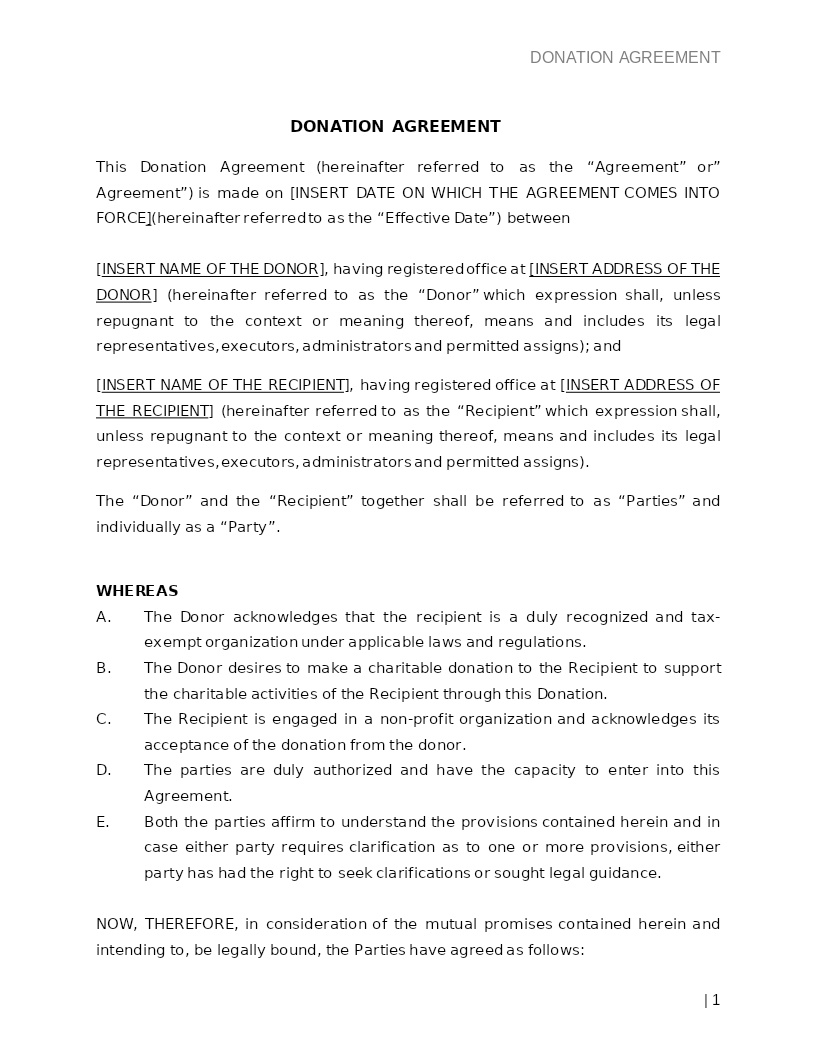
Donation Agreement Template – Draft Format
Donations are often made with positive intentions and mutual trust. However, questions may arise later regarding the purpose of the donation, expectations attached to it, and how the donated resources are used.
Donors frequently seek clarity on matters such as whether funds will be applied to the intended purpose, whether a receipt sufficiently records the transaction, and what legal recourse may exist if the donation is later questioned or misapplied.
Recipients may also face uncertainty. Concerns sometimes arise about whether a donor may attempt to influence how funds are used after the donation has been made, whether expectations were properly documented, or whether informal arrangements could create regulatory or compliance issues in the future.
A Donation Agreement is intended to reduce such uncertainty by recording the understanding between the parties before money, property, goods, or services are transferred. By documenting the purpose, scope, and conditions of a donation, the agreement helps preserve transparency and accountability while supporting lawful charitable or philanthropic activity.
This Donation Agreement template provides a structured framework for documenting voluntary contributions in a clear and organised manner. It is drafted to reflect commonly recognised contract principles and may be adapted to align with applicable governing law and regulatory requirements in different jurisdictions.
Quick Legal Summary (At a Glance)
- Donation agreements generally become legally binding once properly executed by the parties.
- The template provides a framework to record donor intent and recipient responsibilities.
- It addresses purpose-based donations, conditional contributions, reporting obligations, and lawful use of donated assets.
- It may be used in contexts such as charitable donations, corporate social responsibility contributions, institutional support, or private philanthropy.
- Enforceability depends on governing law, charity regulations, and applicable tax or compliance rules.
This summary is provided for general informational purposes and should not be treated as legal advice.
What Is a Donation Agreement and When Do You Need One?
A Donation Agreement is a written contract between a donor and a recipient organisation or individual that documents a voluntary contribution made without expectation of commercial consideration.
The donation may involve money, property, goods, or services. The agreement records the parties’ understanding regarding how the contribution will be transferred and, where applicable, how it may be used.
A Donation Agreement is commonly considered when:
- A contribution is made for a specific programme, initiative, or project
- The donor wishes to document conditions or restrictions attached to the donation
- Reporting or transparency obligations are expected
- The value of the donation is substantial or distributed over time
- The contribution involves cross-border transfers or regulated charitable activities
A structured Donation Agreement typically clarifies:
- The nature and value of the donation
- The intended purpose of the contribution
- Permitted and restricted uses of donated resources
- Reporting, monitoring, or accountability expectations
- Consequences if the donation is not used as agreed
- Governing law and dispute resolution provisions
By documenting these matters in advance, the agreement can help maintain clarity between the parties and reduce the likelihood of misunderstanding.
Types of Donation Agreements Covered by This Template
The template may be adapted to accommodate different forms of philanthropic or charitable contributions.
- Unrestricted Donation Agreement: Used where the recipient is permitted to apply donated funds for its lawful activities without restrictions on a specific project.
- Restricted or Purpose-Specific Donation Agreement: Used where the donor designates a specific programme, activity, or purpose for which the donation must be used.
- Corporate Social Responsibility (CSR) Donation Agreement: Often used when companies contribute resources as part of structured CSR or philanthropic initiatives.
- In-Kind Donation Agreement: Applicable when the contribution involves equipment, goods, materials, or professional services rather than monetary funds.
- Recurring or Instalment-Based Donation Agreement: Used when donations are made periodically or in instalments over a defined timeframe.
The structure of each arrangement may require adjustments depending on the governing legal framework and applicable charity regulations.
Are Donation Agreements Legally Enforceable Internationally?
Donation agreements are generally recognised within many legal systems when they satisfy the essential requirements of contract law, including clarity of terms, lawful purpose, and mutual understanding between the parties.
However, enforcement may depend on compliance with local regulatory requirements. Different jurisdictions may regulate charitable activities in different ways, including rules relating to charity registration, financial reporting, and permissible uses of donated funds.
Courts or regulatory authorities typically evaluate such agreements based on factors such as the documented intent of the parties, lawful use of funds, fairness of terms, and compliance with applicable statutory requirements.
As with most contractual arrangements, a template structure may require modification to align with local legal frameworks.
Considerations in Structuring Donation Agreements
In practice, donation arrangements may raise issues that informal documentation does not fully address. Structured agreements can assist in clarifying expectations and supporting transparency.
Documenting Donor Intent: Clearly recording the purpose of the donation may help ensure the contribution is used in a manner consistent with the donor’s expectations.
Defining Permitted Use of Funds or Assets: The agreement may specify whether the donation is restricted to a particular project or available for general organisational purposes.
Reporting and Accountability: In some situations, donors may request periodic updates, financial reporting, or confirmation of how the donation has been applied.
Compliance with Regulatory Requirements: Certain jurisdictions impose regulatory or reporting obligations on organisations receiving charitable donations, particularly when tax exemptions or public funding is involved.
Clear documentation may assist in addressing these considerations in a structured manner.
When This Donation Agreement Template May Not Be Sufficient
A standard template may not address all legal or regulatory considerations in more complex donation arrangements.
Additional review may be appropriate where:
- The donation involves substantial financial value
- Contributions cross national borders or multiple jurisdictions
- Tax exemptions, deductions, or regulatory approvals are involved
- The recipient organisation operates in a regulated sector
- The donor retains rights relating to monitoring, revocation, or recovery of funds
In such cases, further legal structuring may be necessary to align the agreement with applicable legal and compliance requirements.
Common Donation Agreement Mistakes
In many situations, disputes arise not from the donation itself but from insufficient documentation of expectations.
Examples include:
- Relying solely on informal communications such as emails
- Failing to document restrictions or conditions attached to a donation
- Omitting reporting or transparency obligations
- Assuming goodwill alone eliminates potential legal risk
- Using inconsistent or unverified online templates
Careful documentation can help mitigate these risks.
Who Should Use This Donation Agreement Template?
This template may be used by a variety of individuals and organisations involved in philanthropic or charitable activity, including:
- Charitable organisations and non-governmental organisations (NGOs)
- Corporations making CSR or philanthropic contributions
- Foundations or charitable trusts
- Educational or healthcare institutions receiving donations
- Individuals or families providing substantial gifts or grants
- Sponsors supporting social initiatives or programmes
It serves as a structured starting point for documenting donation arrangements responsibly.
How to Use This Donation Agreement Template
Step-by-Step
- Insert the legal details of the donor and recipient.
- Describe the donation, including its form, value, and transfer method.
- Specify the intended purpose or restrictions, if applicable.
- Define any reporting or accountability expectations.
- Select the governing law and dispute resolution framework.
- Review compliance with applicable charity and tax regulations.
- Execute the agreement through valid electronic or physical signatures.
Electronic signatures are recognised in many jurisdictions, subject to local legal requirements.
Frequently Asked Questions (FAQs)
Is a Donation Agreement valid across different countries?
Donation agreements are commonly recognised under general contract law principles. However, enforceability depends on compliance with applicable charity regulations, tax rules, and governing law in the relevant jurisdictions.
Can a donor place conditions on how the donation is used?
Yes. A donation agreement may record restrictions, designated purposes, or reporting expectations associated with the contribution.
Is a receipt sufficient documentation for a donation?
A receipt typically confirms that a donation was received. It does not normally address the intended purpose, restrictions, or expectations surrounding the donation.
Does a Donation Agreement automatically provide tax benefits?
No. Tax treatment of donations depends on applicable tax laws, charitable registration status, and jurisdiction-specific compliance requirements.
Can the agreement apply to both single donations and recurring support?
Yes. The structure may be used for one-time donations as well as contributions made periodically or in instalments.
Are electronic signatures generally acceptable?
Many jurisdictions recognise electronic signatures where the parties consent and statutory requirements are satisfied.
Important Notice:
This template is provided as a general legal resource and does not constitute legal advice, solicitation, or advertisement within the meaning of the Bar Council of India Rules. Use of this template does not create an advocate-client relationship.
If you are preparing to discuss a business idea, commercial proposal, or funding opportunity, understanding confidentiality safeguards before disclosure is a prudent legal step.
