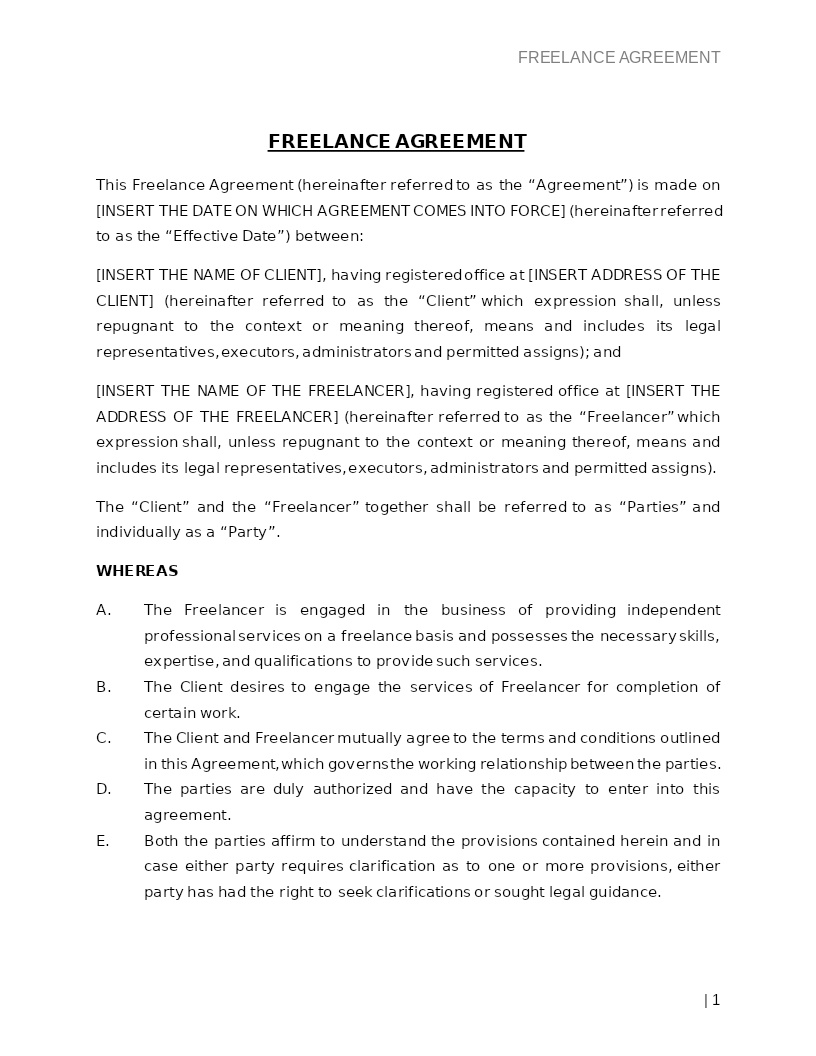
FREELANCE AGREEMENT
How does it work?
1. Choose this template
Start by clicking on "Fill out the template"
2. Complete the document
Answer a few questions and your document is created automatically.
3. Save - Print
Your document is ready! You will receive it in Word and PDF formats. You will be able to modify it.
Freelance Agreement Template- Draft Format
Most freelance engagements begin informally. A client shares a project brief, a freelancer agrees to complete the work, and both sides assume that expectations are clear.
However, many disputes arise not because either party intended to act unfairly, but because important questions were never clearly addressed at the outset.
For example:
- Who owns the final work product?
- When exactly must payment be made?
- What happens if the project scope changes?
- Is the freelancer truly an independent contractor, or could the arrangement resemble employment?
When these issues are not documented early, disagreements may arise later- sometimes after substantial work has already been delivered.
A Freelance Agreement is intended to reduce this uncertainty. It provides a structured legal framework that clarifies the relationship between the client and the freelancer, defines expectations, and creates a reference point if disagreements arise.
This Freelance Agreement template is designed as a general legal framework for documenting freelance or independent contractor engagements. It may be adapted for use across jurisdictions with appropriate governing law provisions, tax considerations, and jurisdiction-specific legal review where required.
Quick Legal Summary (At a Glance)
Freelance Agreements are generally legally enforceable contracts when properly drafted and signed by both parties.
This template is structured to help:
- Establish an independent contractor (non-employment) relationship
- Define the scope of services and deliverables
- Clarify payment timelines and fee structure
- Address intellectual property ownership
- Include confidentiality and termination provisions
While a written agreement can significantly reduce ambiguity, enforceability ultimately depends on applicable contract law, tax compliance, and the actual working relationship between the parties.
For engagements involving cross-border work, valuable intellectual property, or substantial financial exposure, professional legal review may be appropriate before relying on the agreement.
What Is a Freelance Agreement and When Do You Need One?
A Freelance Agreement is a contract between a Client and a Freelancer (Independent Contractor) governing the provision of defined services or deliverables.
The agreement typically outlines:
- The scope of work
- Project timelines or milestones
- Payment structure and due dates
- Intellectual property ownership
- Confidentiality obligations
- Termination rights and remedies
You may consider using a Freelance Agreement when:
- Engaging freelancers, consultants, or gig workers
- Outsourcing design, development, marketing, writing, or advisory services
- Hiring professionals for short-term or project-based work
- Protecting confidential information or proprietary processes
- Clarifying ownership of deliverables
- Reducing employee misclassification risks
A well-structured agreement helps align expectations and may reduce the likelihood of disputes relating to scope, payment, or ownership of work.
Types of Freelance & Independent Contractor Arrangements
Freelance engagements can take several forms depending on the nature of the work and the commercial relationship between the parties.
This template can generally be adapted for different arrangements, including:
- Project-Based Engagements: Defined deliverables completed within a specified timeline for a fixed fee.
- Milestone-Based Work: Payments linked to completion of defined project stages or outputs.
- Ongoing Retainer Arrangements: Recurring services provided periodically without establishing an employment relationship.
- Creative and Content Services: Design, writing, branding, photography, video production, and media services.
- Technology and Software Projects: Development, testing, maintenance, consulting, and technical support services.
- Cross-Border Freelance Engagements: Remote work involving freelancers located in different jurisdictions.
Because legal requirements vary across jurisdictions, certain arrangements may require additional clauses or jurisdiction-specific customization.
Are Freelance Agreements Legally Enforceable Internationally?
Freelance Agreements are widely recognized under general principles of contract law in many jurisdictions. Different jurisdictions may apply varying standards.
- United States: Freelance agreements are governed primarily by contract law. Classification rules distinguishing independent contractors from employees are particularly important.
- United Kingdom & European Union: Contract law generally recognizes freelance agreements, but authorities may examine whether the arrangement effectively constitutes employment.
- United Arab Emirates & Saudi Arabia: Freelance engagements are permitted within regulatory frameworks that may require licensing or documentation depending on the nature of work.
- Australia & Canada: Contract law governs freelance relationships, with emphasis on distinguishing contractors from employees and defining intellectual property ownership.
- India & Southeast Asia: Freelance arrangements are commonly recognized under contract law, and written agreements are generally recommended to clarify scope, payment terms, confidentiality obligations, and tax responsibility.
Across jurisdictions, clear drafting and accurate classification remain important factors for enforceability.
Considerations in Complex Freelance Arrangements
In more complex freelance engagements, additional provisions may be necessary depending on the commercial structure and applicable regulatory requirements.
Examples may include:
- Projects involving significant financial exposure
- Long-term or exclusive contractor relationships
- Engagements involving sensitive intellectual property or trade secrets
- Cross-border arrangements involving multiple legal jurisdictions
- Payment models involving royalties or revenue sharing
- Regulatory or industry-specific compliance obligations
In such situations, modification may be necessary to align with applicable law and organisational requirements.
When This Freelance Agreement Template May Not Be Sufficient
This template is designed for many standard freelance engagements, but it may not address every situation.
Additional legal review may be appropriate if the arrangement involves:
- Mission-critical or high-value projects
- Exclusive contractor relationships
- Sensitive technology or proprietary systems
- Equity participation, royalties, or revenue-sharing structures
- Cross-border tax exposure
- Work in highly regulated sectors such as financial services, healthcare, or data-intensive industries
In such cases, modification may be necessary to align with applicable law and organisational requirements.
Common Mistakes People Make With Freelance Agreements
- Treating freelancers like employees in practice
- Using vague scope descriptions
- Failing to clearly define intellectual property ownership
- Ignoring tax or withholding obligations
- Omitting governing law or jurisdiction clauses
- Relying on generic templates copied from unrelated contexts
Clear documentation may assist in reducing ambiguity in freelance relationships.
Who Should Use This Freelance Agreement Template?
This template may be useful for:
- Businesses engaging freelancers or consultants
- Startups and agencies outsourcing specialised work
- Creative professionals such as designers, writers, and videographers
- Technology teams hiring developers or technical consultants
- Marketing and digital service providers
- Companies working with remote or international freelancers
Because each engagement is different, parties should ensure the agreement accurately reflects the actual working arrangement.
How to Use This Freelance Agreement Template Safely
Step-by-Step
- Click Fill Out the Template
- Enter client and freelancer details
- Define the scope of services and deliverables
- Specify timelines, milestones, and payment structure
- Customize intellectual property and confidentiality provisions
- Select the governing law and jurisdiction
- Review the document for jurisdiction-specific compliance
- Download the agreement in Word or PDF format
- Sign electronically or in person, where legally permitted
Electronic signatures are widely recognized under modern electronic signature frameworks, provided the document clearly reflects the parties’ intent to sign and maintain document integrity.
Frequently Asked Questions (FAQs)
Is a Freelance Agreement legally binding?
Yes. A Freelance Agreement generally becomes legally binding once it is properly drafted and signed by both the Client and the Freelancer. Enforceability depends on applicable contract law and whether the agreement reflects the actual working relationship.
Does a Freelance Agreement create an employment relationship?
No. A Freelance Agreement is typically intended to establish an independent contractor relationship rather than employment. However, regulatory authorities may examine the practical working arrangement if classification disputes arise.
Who owns the intellectual property created by a freelancer?
Ownership depends on the terms of the agreement. In many arrangements, intellectual property transfers to the Client after payment is completed, unless the agreement provides otherwise.
Can this Freelance Agreement be used for short-term or recurring work?
Yes. The agreement may be adapted for one-time projects, milestone-based assignments, or ongoing freelance engagements, depending on how the scope and payment provisions are structured.
Are electronic signatures valid for a Freelance Agreement?
In many jurisdictions, electronic signatures are legally recognized under applicable electronic signature laws, provided the document clearly reflects the parties’ intention to sign.
What happens if either party breaches the Freelance Agreement?
If a breach occurs, the non-breaching party may have the right to terminate the agreement and pursue remedies available under the contract or applicable law, which may include damages or other relief depending on the circumstances.
Download the Freelance Agreement Template
A structured Freelance Agreement can help clarify expectations, document key commercial terms, and provide a written reference point for the freelance engagement.
Important Notice:
This template is provided as a general legal resource and does not constitute legal advice, solicitation, or advertisement within the meaning of the Bar Council of India Rules. Use of this template does not create an advocate-client relationship.
If you are preparing to discuss a business idea, commercial proposal, or funding opportunity, understanding confidentiality safeguards before disclosure is a prudent legal step.
Related Templates You May Need
- Independent Contractor Agreement
- Non-Disclosure Agreement (NDA)
- Intellectual Property (IP) Assignment Agreement
