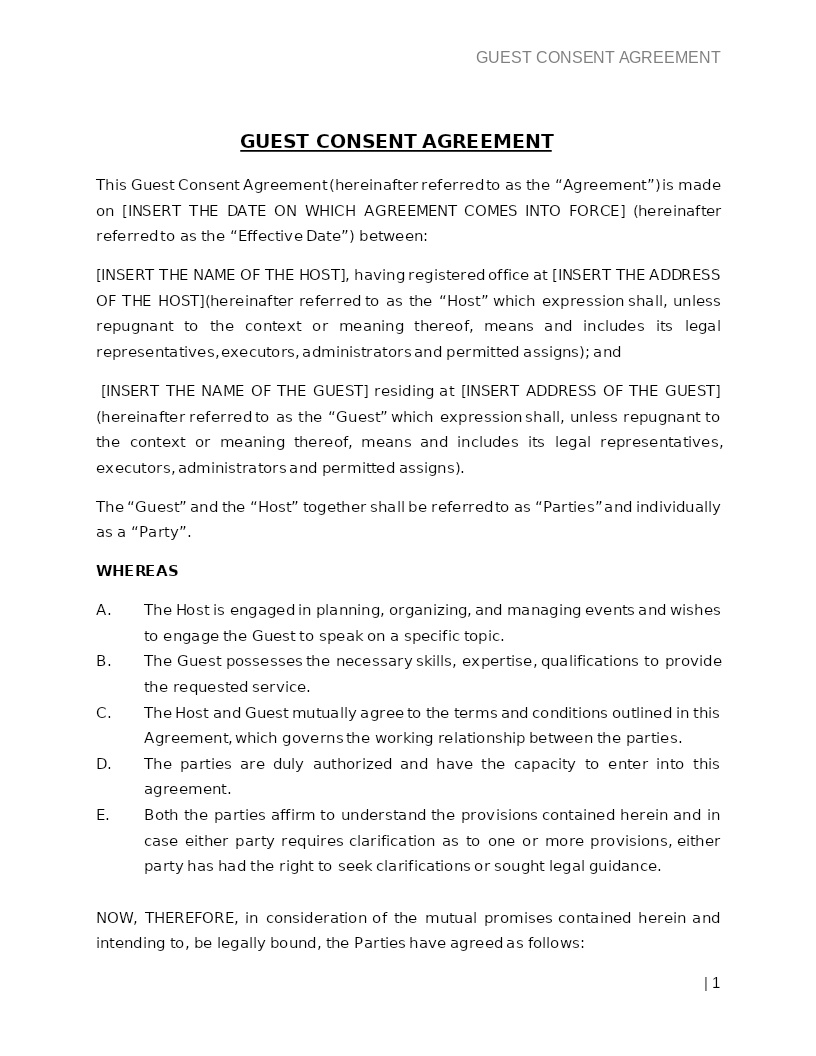
GUEST CONSENT AGREEMENT
How does it work?
1. Choose this template
Start by clicking on "Fill out the template"
2. Complete the document
Answer a few questions and your document is created automatically.
3. Save - Print
Your document is ready! You will receive it in Word and PDF formats. You will be able to modify it.
Guest Consent Agreement – Draft Format
“Do I need written permission before recording a guest?”
“Can someone object later if their interview is published?”
“Is verbal consent enough for podcasts or videos?”
“What if a guest later asks for their content to be removed?”
Media appearances, interviews, podcasts, and recorded discussions often begin informally. Disputes, however, may arise later regarding permission, usage rights, privacy, publication, or commercial distribution of recorded material.
A Guest Consent Agreement exists to reduce that uncertainty.
This Guest Consent Agreement template provides a structured legal framework for documenting a guest’s voluntary consent to be recorded, photographed, interviewed, or featured in media content. It is drafted in line with commonly recognised legal principles relating to consent, publicity rights, privacy protections, and contractual documentation across multiple jurisdictions.
It is designed to be adapted based on governing law and applicable privacy or media regulations.
It is not a substitute for legal advice in complex situations. It is intended as a practical starting point.
Quick Legal Summary (At a Glance)
• Guest consent agreements are generally enforceable when consent is voluntary, informed, and clearly documented.
• This template provides a structured framework for recording permission to use a guest’s name, voice, likeness, and statements.
• Enforceability may depend on governing law, privacy legislation, publicity rights, and media regulations.
• Consent agreements cannot override statutory privacy protections or data protection obligations.
• For commercial advertising use, minors, cross-border distribution, or sensitive subject matter, legal review may be advisable.
This summary is provided for general informational purposes and does not constitute legal advice.
What Is a Guest Consent Agreement and When Do You Need One?
A Guest Consent Agreement is a written document through which an individual voluntarily grants permission to be recorded, photographed, interviewed, or featured in content produced by a creator, organisation, or media entity.
It clarifies how a guest’s name, image, voice, statements, and participation may be used, published, distributed, or archived.
You may typically require a Guest Consent Agreement when:
• Recording podcast interviews
• Filming YouTube or online video content
• Conducting webinars, workshops, or panel discussions
• Producing documentaries or recorded interviews
• Using testimonials or public statements in media content
• Photographing individuals for promotional or editorial purposes
A well-structured guest consent agreement generally defines:
• The nature and purpose of the recording or appearance
• Permission to record audio, video, or photographs
• Scope of use and distribution rights
• Media formats and publication platforms
• Consent for editing or excerpts
• Privacy and publicity acknowledgements
• Governing law and dispute resolution provisions
Clear documentation helps confirm voluntary participation and reduces misunderstandings regarding how recorded material may be used.
Types of Guest Consent Arrangements
This template may be adapted for different participation contexts depending on the nature of the recording and applicable legal considerations.
1. Podcast or Interview Guest Consent: Used for individuals appearing in podcasts, livestream discussions, recorded interviews, or online video content.
2. Event or Webinar Participation Consent: Used when speakers, panelists, or participants appear in recorded workshops, conferences, or digital events.
3. Photography or Media Release Consent: Used when individuals are photographed or filmed for publication, editorial use, or promotional material.
4. Minor Participation Consent: Used when parents or legal guardians grant permission for individuals below the age of majority to appear in recordings or media content.
5. Testimonial or Public Statement Consent: Used when individuals provide statements, feedback, or experiences that may be published or referenced in content.
Each arrangement may require modifications depending on jurisdiction, privacy regulations, and the intended use of the recorded material.
Are Guest Consent Agreements Legally Enforceable Internationally?
Guest consent agreements are widely recognised under principles of contract law, privacy rights, and publicity rights. However, enforceability depends on several factors, including:
• Voluntary and informed consent
• Clear documentation of usage rights
• Compliance with applicable privacy and data protection laws
• Lawful purpose and responsible publication
Legal frameworks vary between jurisdictions. For example:
United States: Rights of publicity and privacy laws govern commercial use of a person’s name or likeness. Written consent is generally advisable for publication or promotional use.
United Kingdom & European Union: Data protection and privacy laws, including the General Data Protection Regulation (GDPR), emphasise informed and explicit consent when personal data is recorded or published.
United Arab Emirates & Saudi Arabia: Media and civil laws recognise personal privacy rights, and unauthorised publication may create legal exposure.
Australia & Canada: Privacy legislation and common law protections may apply to image use, recordings, and public representation.
India & Southeast Asia: Contract law principles and evolving privacy jurisprudence recognise the importance of voluntary consent for recording and publication of personal information.
Courts generally assess such agreements based on clarity, fairness, and lawful consent.
No template guarantees universal enforceability.
Considerations in Media and Recording Arrangements
Generic online forms may omit important safeguards relevant to media content.
Depending on the nature of the recording, additional considerations may arise.
Clear Scope of Consent: Defining whether the guest consents to recording, editing, and publication helps reduce disputes.
Defined Usage Rights: Clarifying where and how recordings may be used helps manage expectations regarding distribution.
Editing and Excerpt Rights: Content creators often require permission to edit or reproduce excerpts of recorded material.
Privacy and Data Protection: Recording personal information may trigger obligations under privacy and data protection regulations.
Duration of Usage: Some agreements specify whether content may be used indefinitely or for a defined period.
Clear documentation helps establish transparency between participants and content producers.
When This Guest Consent Agreement Template May Not Be Sufficient
A template may not be adequate where:
• Recordings involve minors or vulnerable individuals
• Content will be used in commercial advertising campaigns
• Sensitive topics or confidential information are discussed
• Multiple jurisdictions govern distribution
• Significant reputational or regulatory risks exist
• Data protection obligations are complex
In such cases, additional legal review or customised drafting may be appropriate.
Common Mistakes in Guest Consent Documentation
Many disputes arise from avoidable documentation issues, such as:
• Relying solely on verbal consent
• Failing to define how content will be used
• Using unclear or overly broad permissions
• Ignoring privacy or data protection requirements
• Recording individuals without written acknowledgment
• Copying inconsistent clauses from unrelated templates
Careful drafting and transparent communication can reduce the likelihood of such issues.
Who Should Use This Guest Consent Agreement Template?
This template may be useful for:
• Podcast hosts and content creators
• Documentary producers and media teams
• Event organisers and webinar hosts
• Photographers and videographers
• Organisations recording interviews or testimonials
• Educational platforms hosting guest speakers
It provides a structured starting point for documenting guest participation in recorded content.
How to Use This Guest Consent Agreement Template Safely
Step-by-Step
- Enter the guest’s legal name and identifying details.
- Describe the recording activity (interview, event, podcast, etc.).
- Specify whether audio, video, or photographs will be captured.
- Define how the recorded material may be used or distributed.
- Include editing and reproduction permissions if relevant.
- Select governing law consistent with the applicable jurisdiction.
- Execute the agreement through valid electronic or physical signature.
Electronic signatures are recognised in many jurisdictions, subject to applicable law and consent requirements.
Frequently Asked Questions (FAQs)
Is this Guest Consent Agreement valid internationally?
It provides a general framework that can be adapted across jurisdictions. Enforceability depends on compliance with local privacy laws and governing law provisions.
Is verbal consent sufficient?
In many contexts, verbal consent may not provide clear evidence if disputes arise. Written consent is generally considered more reliable.
Can this template be used for minors?
Yes, but consent must typically be provided by a parent or legal guardian in accordance with applicable law.
Can a guest withdraw consent after recording?
Revocation rights may vary depending on jurisdiction, contractual terms, and whether the content has already been published.
Does this allow use on social media or digital platforms?
The template can include provisions covering online platforms, broadcast media, and digital distribution.
Download the Guest Consent Agreement Template
This Guest Consent Agreement template provides a structured framework for documenting consent to recording, media participation, and publication of guest appearances.
It is intended to promote clarity, transparency, and responsible use of recorded content when adapted appropriately to applicable law.
Important Notice
This template is provided as a general legal resource and does not constitute legal advice, solicitation, or advertisement within the meaning of the Bar Council of India Rules. Use of this template does not create an advocate-client relationship.
Users should independently evaluate whether the document is suitable for their particular circumstances.
Related Templates You May Need
• Model Release Form
• Influencer Agreement
• Non-Disclosure Agreement (NDA)
