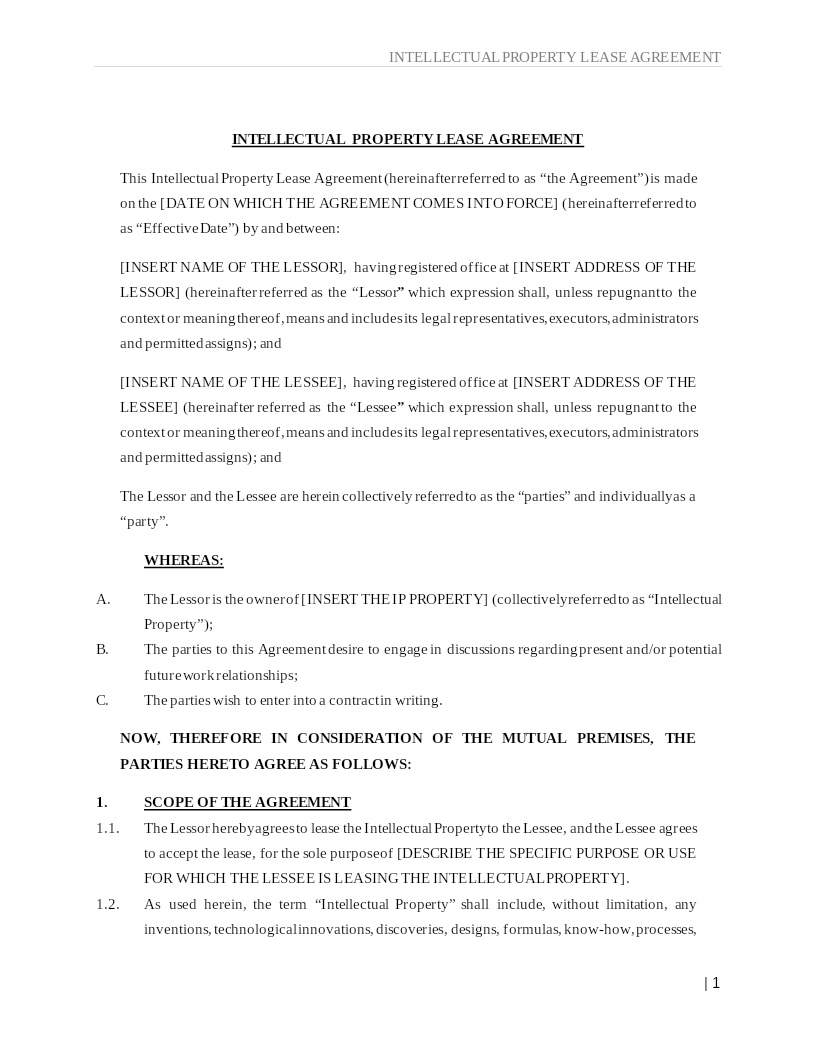
INTELLECTUAL PROPERTY LEASE AGREEMENT
How does it work?
1. Choose this template
Start by clicking on "Fill out the template"
2. Complete the document
Answer a few questions and your document is created automatically.
3. Save - Print
Your document is ready! You will receive it in Word and PDF formats. You will be able to modify it.
Intellectual Property Lease Agreement – Draft Format
“Can someone legally use my intellectual property without owning it?”
“What if the other party misuses my patent, trademark, or software?”
“Does leasing intellectual property affect my ownership rights?”
“Is a template agreement legally sufficient to protect my IP?”
Intellectual property transactions often begin with commercial opportunity. Disputes, however, may arise later over scope of use, royalties, sublicensing, confidentiality, duration of rights, or misuse of proprietary assets that were never clearly documented.
An Intellectual Property Lease Agreement exists to reduce that uncertainty.
This Intellectual Property Lease Agreement template provides a structured legal framework for documenting the temporary use of intellectual property assets while preserving ownership rights. It is drafted in line with commonly accepted intellectual property and contract law principles across multiple jurisdictions and is designed to be adapted to applicable governing law and regulatory requirements.
It is not a substitute for legal advice in complex or high-value IP transactions. It is intended as a structured starting point.
This structure follows the same legal explanation framework used in the Employment Agreement documentation to promote clarity and responsible use of legal templates.
Quick Legal Summary (At a Glance)
• Intellectual Property Lease Agreements are legally binding when properly drafted and executed.
• This template provides a structured framework for temporarily granting usage rights while preserving ownership.
• Enforceability depends on governing law, statutory IP regulations, and proper contractual implementation.
• IP leasing agreements cannot override mandatory intellectual property laws or registration requirements.
• For cross-border licensing, high-value patents, technology transfer, or regulated industries, legal review is strongly advisable.
This summary is provided for general informational purposes and does not constitute legal advice.
What Is an Intellectual Property Lease Agreement and When Do You Need One?
An Intellectual Property Lease Agreement is a legally binding contract between an IP owner (the Lessor) and another party (the Lessee) that grants the right to use specific intellectual property for a defined period under agreed conditions.
Unlike an assignment, which transfers ownership, a lease allows the IP owner to retain title while allowing controlled commercial use.
You may require an Intellectual Property Lease Agreement when:
• Allowing another party to temporarily use a patent, trademark, software, or copyrighted material
• Monetising intellectual property without transferring ownership
• Granting limited commercial usage rights to partners or distributors
• Leasing proprietary technology or know-how for operational use
• Allowing controlled brand or trademark usage
• Structuring technology collaborations or product integrations
A well-structured intellectual property lease agreement generally defines:
• The intellectual property being leased
• Permitted and prohibited uses
• Duration of usage rights
• Payment terms or royalty arrangements
• Confidentiality and protection obligations
• Quality control requirements (for trademarks)
• Restrictions on sublicensing or modification
• Termination and dispute resolution provisions
• Governing law and jurisdiction
Clear documentation helps reduce ambiguity and preserve ownership rights while enabling lawful commercial use.
Types of Intellectual Property Leasing Arrangements
This template may be adapted for different types of intellectual property assets, subject to jurisdiction-specific legal requirements.
1. Patent Leasing: Allows temporary use of patented inventions, processes, or technologies without transferring patent ownership.
2. Trademark or Brand Leasing: Permits controlled use of a brand name, logo, or mark under strict quality control requirements.
3. Copyright Leasing: Allows use of protected creative works such as software, designs, content, music, or photography.
4. Technology or Software Leasing: Used for proprietary systems, applications, algorithms, or platforms where ownership remains with the developer.
5. Trade Secret or Know-How Leasing: Allows controlled access to confidential methods, formulas, operational knowledge, or business systems.
Each structure may require additional provisions depending on regulatory or industry-specific requirements.
Are Intellectual Property Lease Agreements Legally Enforceable Internationally?
Intellectual property lease agreements are widely recognised under contract and intellectual property law frameworks. However, enforceability depends on several factors:
• Clear identification of the IP asset
• Lawful purpose and commercial intent
• Compliance with national intellectual property laws
• Proper contractual documentation and implementation
Legal treatment may differ across jurisdictions. For example:
United States: Governed by federal intellectual property statutes such as the Patent Act, Copyright Act, and Lanham Act, alongside state contract law.
United Kingdom & European Union: Subject to statutory intellectual property regimes and EU directives governing licensing and technology transfer.
United Arab Emirates & Saudi Arabia: Intellectual property rights are protected through national IP laws and commercial regulations.
Australia & Canada: Governed by federal IP legislation and contract law principles.
India & Southeast Asia: Intellectual property leasing arrangements operate under statutes such as the Copyright Act, Patents Act, and Trade Marks Act together with contract law principles.
Courts typically assess IP agreements based on legality, clarity of rights granted, and compliance with statutory requirements.
No template guarantees universal enforceability.
Considerations in Complex Intellectual Property Transactions
Generic templates may omit provisions that become critical in commercial IP arrangements.
In complex transactions, additional provisions may be necessary depending on the nature of the intellectual property and the commercial relationship.
Clear Scope of Use: Defines exactly how the IP may be used and prevents unauthorised exploitation.
Royalty or Payment Structure: Clarifies fixed fees, recurring payments, or usage-based royalties.
Quality Control Provisions: Particularly important for trademarks to protect brand reputation.
Confidentiality Safeguards: Protect trade secrets, proprietary processes, and sensitive technical information.
Termination and Revocation Rights: Provides mechanisms to suspend or terminate use if contractual obligations are breached.
Proper drafting helps reduce misuse risks and preserve the value of intellectual property assets.
When This Intellectual Property Lease Agreement Template May Not Be Sufficient
A template may not be adequate in situations such as:
• Cross-border technology transfers
• High-value patent portfolios
• Complex software licensing structures
• Joint research and development arrangements
• Government-regulated industries
• Transactions involving significant revenue or royalty streams
In such cases, tailored legal drafting may be required to ensure compliance with regulatory frameworks and intellectual property registration systems.
Common Mistakes in Intellectual Property Lease Agreements
Disputes frequently arise from preventable drafting errors, including:
• Unclear definition of the intellectual property being leased
• Failure to restrict unauthorised sublicensing
• Absence of quality control provisions for trademarks
• Inadequate confidentiality protections
• Ambiguous royalty structures
• Incorrect governing law provisions
Understanding these risks helps ensure responsible use of intellectual property documentation.
Who Should Use This Intellectual Property Lease Agreement Template?
This template may be useful for:
• Intellectual property owners seeking to monetise their assets
• Technology companies licensing proprietary systems
• Startups commercialising patents or software
• Brand owners granting controlled trademark usage
• Creators leasing copyrighted works
• Businesses collaborating through technology or know-how sharing
It serves as a structured starting point for documenting intellectual property usage rights responsibly.
How to Use This Intellectual Property Lease Agreement Template Safely
Step-by-Step
- Identify the intellectual property being leased and verify ownership.
- Clearly define the permitted scope of use.
- Specify the lease duration and renewal terms.
- Define payment structure or royalty arrangements.
- Include confidentiality and IP protection provisions.
- Select governing law consistent with applicable jurisdiction.
- Execute the agreement through valid electronic or physical signature.
Electronic signatures are generally recognised in many jurisdictions, subject to applicable legal requirements.
Frequently Asked Questions (FAQs)
Is this Intellectual Property Lease Agreement valid internationally?
It provides a general structure adaptable across jurisdictions. Enforceability depends on compliance with applicable intellectual property laws.
Does leasing intellectual property transfer ownership?
No. Ownership remains with the IP holder unless a separate assignment agreement is executed.
Can multiple IP assets be included in one agreement?
Yes, provided each asset is clearly identified and described.
Can the lessee sublicense the IP?
Only if the agreement expressly allows it.
Are royalties mandatory in IP lease agreements?
No. Agreements may involve fixed payments, revenue-based royalties, or other compensation structures.
Can the agreement restrict geographic use?
Yes. Territorial limitations are commonly used in IP licensing and leasing arrangements.
Can the IP owner terminate the lease if misuse occurs?
Typically yes, subject to contractual termination provisions and applicable law.
Download the Intellectual Property Lease Agreement Template
This Intellectual Property Lease Agreement template provides a structured framework for documenting the temporary use of intellectual property while preserving ownership rights.
It is designed to support clarity, responsible documentation, and legal compliance when properly adapted to applicable law.
Important Notice
This template is provided as a general legal resource and does not constitute legal advice, solicitation, or advertisement within the meaning of the Bar Council of India Rules.
Use of this template does not create an advocate-client relationship.
Related Templates You May Need
• Intellectual Property Assignment Agreement
• Copyright License Agreement
• Technology Licensing Agreement
