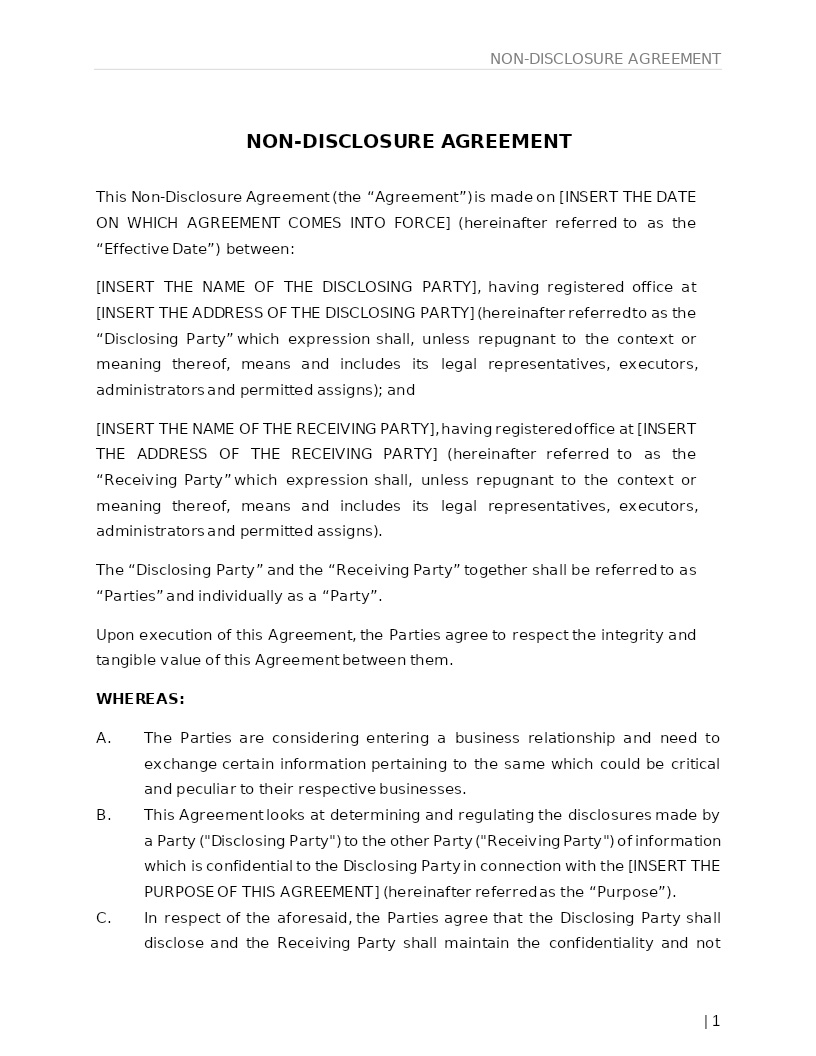
NON-DISCLOSURE AGREEMENT (NDA) TEMPLATE
How does it work?
1. Choose this template
Start by clicking on "Fill out the template"
2. Complete the document
Answer a few questions and your document is created automatically.
3. Save - Print
Your document is ready! You will receive it in Word and PDF formats. You will be able to modify it.
Non-Disclosure Agreement (NDA) Template - Draft Format
A Non-Disclosure Agreement (NDA) exists precisely for situations where confidential information must be shared with defined safeguards in place. It helps establish clear confidentiality obligations before disclosure and reduces the risk of misuse or unauthorised dissemination.
This NDA template provides a structured general framework for protecting confidential information. It is intended for informational purposes and may be adapted in accordance with applicable law, governing law selection, and jurisdiction-specific requirements.
Quick Legal Summary (At a Glance)
- NDAs are generally legally binding when properly drafted, executed, and supported by lawful consideration.
- This template provides a structured confidentiality framework for general use.
- Enforceability depends on clarity, governing law, jurisdiction, and correct execution.
- For high-value, regulated, or cross-border matters, professional legal review is advisable.
What Is a Non-Disclosure Agreement (NDA) and When Do You Need One?
A Non-Disclosure Agreement (NDA), also referred to as a confidentiality agreement, is a legally recognised contract under contract law that obligates one or more parties to maintain confidentiality of specified information.
You may consider using an NDA when sharing:
- Business concepts, proposals, or commercial strategies
- Client, customer, or vendor information
- Financial or operational data
- Software, processes, or proprietary know-how
- Trade secrets or internal documentation
A structured NDA template typically defines:
- What constitutes confidential information
- Permitted and restricted uses of such information
- Authorised disclosures (if any)
- Duration of confidentiality obligations
- Consequences of breach
NDAs protect defined confidential information rather than abstract ideas in isolation. Clear documentation may assist in reducing ambiguity and supporting enforceability, subject to applicable law.
Types of NDAs: Unilateral, Mutual and Multilateral
This NDA template may be structured in different formats depending on the nature of disclosure:
- Unilateral Non-Disclosure Agreement: Used when only one party discloses confidential information, such as a company sharing proprietary information with a consultant or vendor.
- Mutual NDA Agreement: Applicable when both parties exchange confidential information. Common in collaborations, joint discussions, and preliminary negotiations.
- Multilateral Non-Disclosure Agreement: Used where three or more parties share confidential information for a defined purpose, avoiding multiple separate agreements.
Are NDAs Legally Enforceable Internationally?
Non-Disclosure Agreements are generally recognised under contract law across jurisdictions. Enforceability depends on lawful purpose, clarity of scope, reasonable restrictions, governing law selection, and compliance with local legal requirements.
This template is designed for cross-border adaptability, subject to jurisdiction-specific modifications.
- India: NDAs are enforceable under the Indian Contract Act, 1872, provided lawful consideration, free consent, and clear obligations are established.
- United States: Governed by state contract laws. Courts assess reasonableness, clarity, and public policy considerations.
- United Kingdom & European Union: Enforced under contract law and equitable confidentiality principles. Where personal data is involved, compliance with data protection laws such as GDPR is required.
- United Arab Emirates & Saudi Arabia: Recognised under civil and commercial laws, subject to local legal principles and public policy.
- Australia & Canada: Generally enforceable where reasonable in scope and clearly drafted.
- Hong Kong: Governed by contractual and common-law confidentiality principles.
Considerations in Complex Confidentiality Arrangements
In complex commercial structures, additional provisions may be required depending on statutory obligations, regulatory compliance requirements, and the specific commercial context.
Such provisions may include enhanced data protection clauses, industry-specific compliance language, cross-border enforceability considerations, and transaction-specific confidentiality mechanisms.
When This NDA Template May Not Be Sufficient
This template is structured for general confidentiality arrangements. In complex or high-value matters, additional provisions may be required depending on the transaction structure and applicable law.
• Investment or fundraising negotiations
• High-value mergers, acquisitions, or asset transfers
• Intellectual property assignment or licensing
• Regulated industries (fintech, healthcare, data-intensive businesses)
• Multi-jurisdictional transactions
• Highly sensitive trade secrets
Common Mistakes in Using NDAs
Confidentiality disputes often arise due to avoidable errors such as:
• Executing the NDA after disclosure has already occurred
• Using identical templates for materially different transactions
• Failing to define confidential information precisely
• Omitting governing law and jurisdiction clauses
• Assuming an NDA protects undeveloped ideas automatically
• Relying on unverified online templates without review
Who May Use This NDA Template?
This general confidentiality agreement template may be considered by:
• Startups sharing proposals with collaborators
• Consultants and freelancers handling client data
• Businesses outsourcing services
• Companies entering preliminary discussions
• Professionals exchanging proprietary documentation
It serves as an informational starting point and may require modification based on context.
How to Use This NDA Template
Step-by-Step:
- Select the relevant template format (unilateral, mutual, or multilateral)
- Insert accurate party details
- Clearly define the purpose and scope of disclosure
- Specify confidentiality duration
- Select governing law and dispute resolution mechanism
- Review carefully before execution
- Download in Word or PDF format
Electronic and physical signatures are generally recognised where legally valid and consent is clearly recorded.
Frequently Asked Questions (FAQs)
Can I use the same NDA for every situation?
Not necessarily. Employment, consultancy, partnership, and investment contexts may require specific clauses.
Do NDAs protect business ideas?
They protect clearly defined confidential information, not abstract ideas unless properly documented.
Is this NDA template valid internationally?
It is structured for cross-border adaptability; however, enforceability depends on governing law and local compliance.
Do NDAs expire?
Most NDAs specify a defined confidentiality period, often ranging from 1 to 5 years, depending on the nature of information.
Download the NDA Template
Access a structured Non-Disclosure Agreement (NDA) template designed to provide a clear confidentiality framework for general business use.
Important Notice:
This template is provided as a general legal resource and does not constitute legal advice, solicitation, or advertisement within the meaning of the Bar Council of India Rules. Use of this template does not create an advocate-client relationship.
If you are preparing to discuss a business idea, commercial proposal, or funding opportunity, understanding confidentiality safeguards before disclosure is a prudent legal step.
Related Templates You May Need
• Consulting Services Agreement
