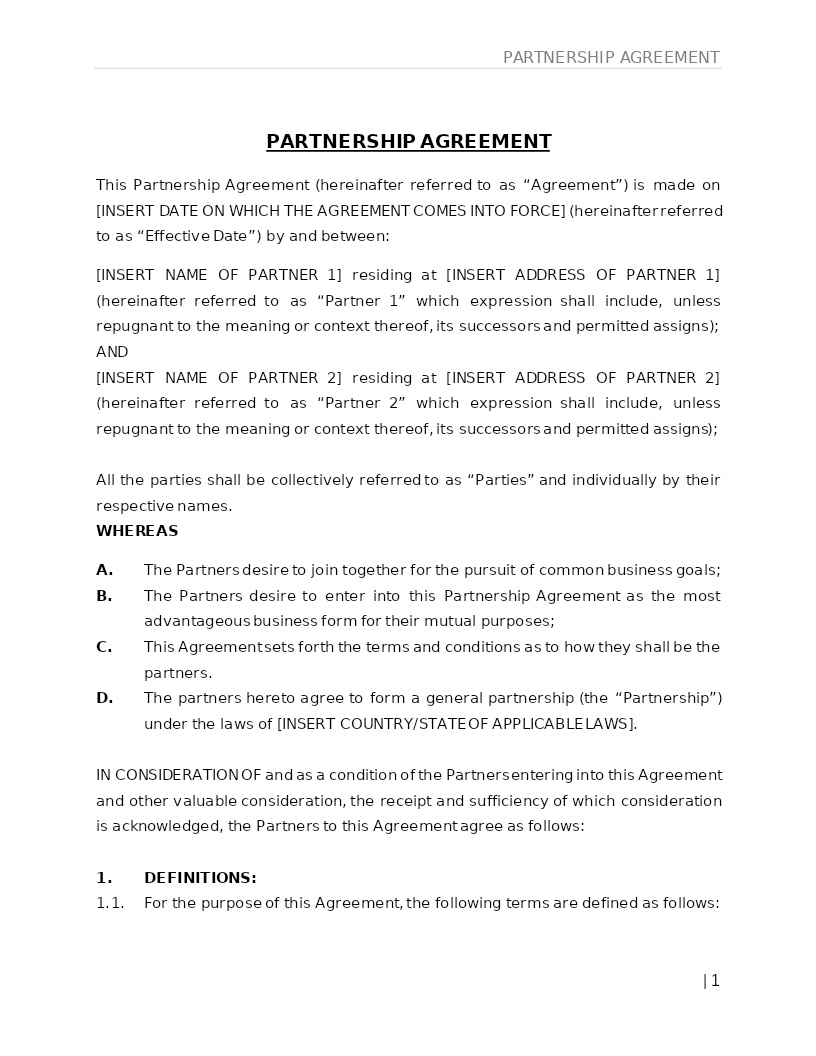
PARTNERSHIP AGREEMENT
How does it work?
1. Choose this template
Start by clicking on "Fill out the template"
2. Complete the document
Answer a few questions and your document is created automatically.
3. Save - Print
Your document is ready! You will receive it in Word and PDF formats. You will be able to modify it.
Partnership Agreement – Draft Format
“Will this partnership arrangement actually protect the partners?”
“What happens if partners disagree later?”
“Can profits be shared in any way we decide?”
“What if a partner leaves or the business fails?”
Business partnerships often begin with trust, shared enthusiasm, and informal understandings. However, disputes frequently arise later over profit sharing, capital contributions, management authority, liabilities, or exit arrangements that were never clearly documented.
A Partnership Agreement exists to reduce that uncertainty.
This Partnership Agreement template provides a structured legal framework for documenting the rights and obligations of partners in a business venture. It reflects commonly recognised partnership law principles across multiple jurisdictions and is designed to be adapted to the governing law applicable to the partnership.
It is not a substitute for legal advice in complex situations. It is intended as a structured starting point for documenting partnership arrangements responsibly.
Quick Legal Summary (At a Glance)
• Partnership agreements become legally binding when properly executed by the partners.
• This template provides a structured framework for defining partner roles, capital contributions, and profit-sharing arrangements.
• Enforceability depends on governing law, partnership statutes, and compliance with applicable regulatory requirements.
• Partners may remain jointly or jointly and severally liable for partnership obligations depending on jurisdiction.
• Complex or high-risk partnerships may require professional legal review before implementation.
This summary is provided for general informational purposes and does not constitute legal advice.
What Is a Partnership Agreement and When Do You Need One?
A Partnership Agreement is a legally binding contract between two or more individuals or entities who agree to carry on a business together for mutual profit.
It defines how the partnership will operate, how profits and losses will be allocated, and how decisions affecting the business will be made.
You typically need a Partnership Agreement when:
• Two or more individuals start a business together
• Co-founders contribute capital or expertise to a joint venture
• Family businesses formalise operational and financial arrangements
• Professional firms operate under a shared business structure
• Business partners wish to clarify management rights and exit procedures
A well-structured partnership agreement generally defines:
• Capital contributions of each partner
• Profit and loss sharing arrangements
• Management roles and decision-making authority
• Duties and responsibilities of partners
• Admission of new partners
• Withdrawal, retirement, or death of a partner
• Dissolution procedures and asset distribution
• Governing law and dispute resolution
Clear documentation helps reduce misunderstandings and provides a structured reference if disputes arise.
Types of Partnership Structures
This template may be adapted to reflect different partnership arrangements, subject to local law and regulatory requirements.
- General Partnership: All partners participate in management and may share liability for partnership obligations.
- Limited Partnership: Certain partners may act as investors with limited liability, while managing partners assume operational control.
- Professional Partnership: Common among law firms, accounting firms, and consulting practices where professionals operate under shared governance.
- Strategic or Project-Based Partnerships: Used when partners collaborate on a specific commercial venture or project.
Each structure may require jurisdiction-specific modifications to remain enforceable.
Are Partnership Agreements Legally Enforceable Internationally?
Partnership agreements are generally recognised under contract and partnership law frameworks worldwide. However, enforceability depends on several factors:
• Lawful business purpose
• Clear contractual terms
• Compliance with partnership legislation
• Proper execution and implementation
Legal treatment varies across jurisdictions. For example:
United States: Governed by state partnership laws such as the Uniform Partnership Act (UPA) and Revised Uniform Partnership Act (RUPA).
United Kingdom & European Union: Recognised under partnership statutes and contract law principles.
United Arab Emirates & Saudi Arabia: Partnership structures must comply with commercial and company law regulations.
Australia & Canada: Partnership statutes and fiduciary duty principles govern partner conduct.
India & Southeast Asia: Partnerships are typically governed by partnership acts and contract law frameworks.
Courts generally assess partnership agreements based on clarity, fairness, and compliance with applicable statutory provisions.
No template can guarantee universal enforceability.
Considerations in Partnership Arrangements
Generic templates sometimes omit provisions that become important once the business begins operating.
In partnership arrangements, additional provisions may be necessary depending on the commercial and regulatory context.
Capital Contribution Structure: Clear documentation of financial or asset contributions reduces later disputes.
Profit and Loss Allocation: Explicit allocation formulas prevent misunderstandings regarding financial distributions.
Management Authority: Defining decision-making processes improves operational efficiency and governance clarity.
Partner Duties and Fiduciary Obligations: Partners often owe duties of good faith, loyalty, and disclosure depending on jurisdiction.
Exit and Dissolution Mechanisms: Clearly defined exit processes may reduce disruption if a partner withdraws or the partnership ends.
When This Partnership Agreement Template May Not Be Sufficient
A template may not be adequate if:
• The partnership operates across multiple jurisdictions
• Significant investment or external funding is involved
• Intellectual property ownership is central to the business
• Regulatory approvals or licensing requirements apply
• Complex tax structures are involved
• The partnership involves high-value commercial risk
In such cases, the agreement may require substantial modification to align with applicable laws and the commercial structure of the business.
Common Mistakes in Partnership Agreements
Many partnership disputes arise from preventable drafting or implementation issues, including:
• Failing to document capital contributions clearly
• Assuming equal profit sharing without written confirmation
• Lack of clear decision-making procedures
• Missing partner exit or buyout provisions
• Ignoring fiduciary duties or conflict-of-interest rules
• Copying clauses from unrelated legal templates
Awareness of these risks helps ensure responsible documentation of partnership relationships.
Who Should Use This Partnership Agreement Template?
This template is commonly used by:
• Entrepreneurs starting a business with co-founders
• Small and medium enterprises forming strategic partnerships
• Professional service partnerships
• Family businesses establishing formal governance structures
• Individuals collaborating on a commercial venture
It serves as a structured starting point for documenting partnership arrangements responsibly.
How to Use This Partnership Agreement Template Safely
Step-by-Step
- Enter the legal names and addresses of all partners.
- Clearly define the business purpose and scope of the partnership.
- Document capital contributions made by each partner.
- Specify profit-sharing and loss-allocation arrangements.
- Define decision-making authority and operational responsibilities.
- Include provisions for partner withdrawal, retirement, or dissolution.
- Select governing law consistent with the jurisdiction of the partnership.
- Execute the agreement through valid electronic or physical signatures.
Electronic signatures are recognised in many jurisdictions, subject to applicable legal requirements.
Frequently Asked Questions (FAQs)
Is a Partnership Agreement legally binding?
Yes. Once signed by the partners, it forms a binding contract governing the rights and obligations of the parties.
Is a written partnership agreement mandatory?
In many jurisdictions it is not mandatory, but relying on statutory default rules may create uncertainty. Written agreements are generally recommended.
Can partners share profits unequally?
Yes. Partners may agree on any profit-sharing ratio, subject to applicable law and tax considerations.
What happens if a partner leaves?
A properly drafted partnership agreement typically includes withdrawal, retirement, or buy-out mechanisms.
Does the agreement protect partners from liability?
Liability depends on the partnership structure and governing law. Some structures impose joint liability on partners.
Can disputes be resolved through arbitration?
Yes. Partnership agreements commonly include dispute resolution clauses such as arbitration or mediation.
Download the Partnership Agreement Template
This Partnership Agreement template provides a structured framework for documenting partnership arrangements in a clear and responsible manner.
It is designed to promote transparency, reduce misunderstandings, and support orderly business operations when adapted to applicable law.
Important Notice
This template is provided as a general legal resource and does not constitute legal advice, solicitation, or advertisement within the meaning of the Bar Council of India Rules.
Use of this template does not create an advocate-client relationship. Users should consider reviewing the document in light of applicable laws, regulations, and commercial circumstances.
Related Templates You May Need
• Joint Venture Agreement
• Non-Disclosure Agreement (NDA)
• Shareholders’ Agreement
• Founders’ Agreement
