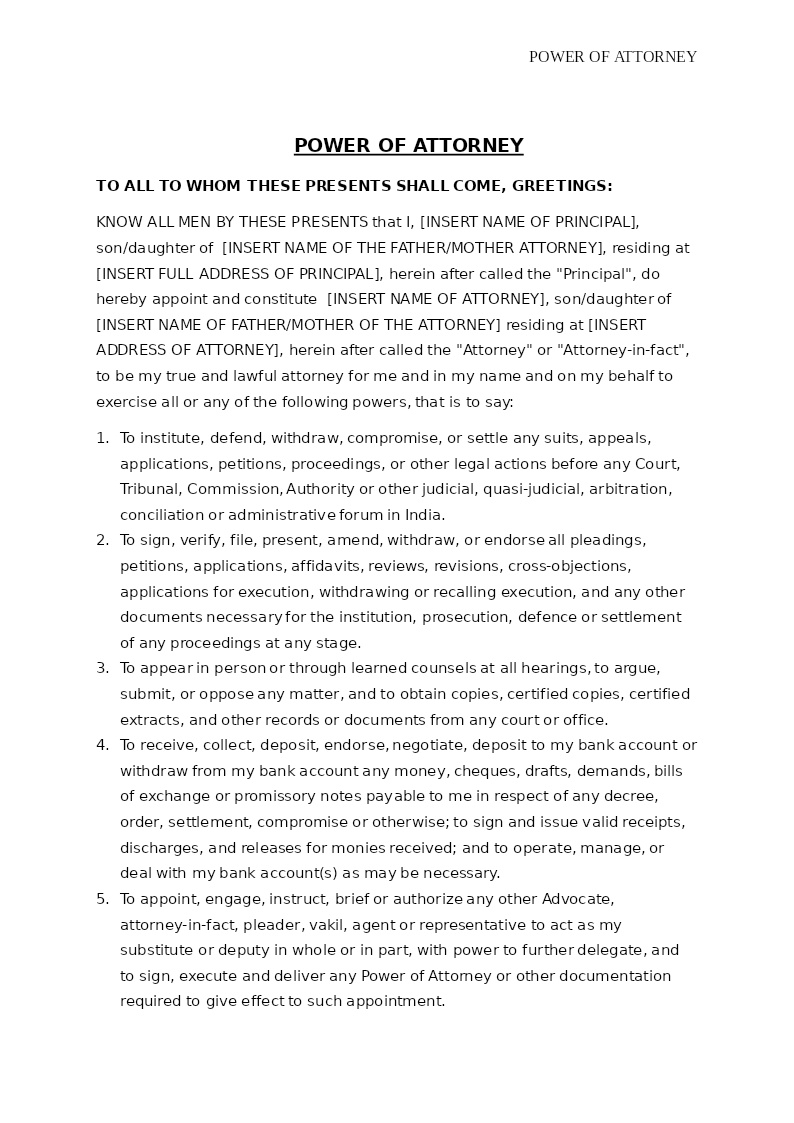
POWER OF ATTORNEY
How does it work?
1. Choose this template
Start by clicking on "Fill out the template"
2. Complete the document
Answer a few questions and your document is created automatically.
3. Save - Print
Your document is ready! You will receive it in Word and PDF formats. You will be able to modify it.
Power of Attorney (POA) Template - Draft Format
A Power of Attorney (POA) exists precisely for situations where one person authorises another to act on their behalf in legal, financial, property, or administrative matters. It helps establish clear authority, scope of powers, and responsibilities granted to the authorised representative.
This Power of Attorney template provides a structured general framework for delegating legal authority. It is intended for informational purposes and may be adapted in accordance with applicable law, governing law selection, and jurisdiction-specific requirements.
Quick Legal Summary (At a Glance)
Powers of Attorney are generally legally valid when properly drafted, executed, and supported by lawful authorisation. This template provides a structured framework for granting authority to act on behalf of another person. Enforceability depends on clarity of powers granted, governing law, jurisdiction, and proper execution.
What Is a Power of Attorney (POA) and When Do You Need One?
A Power of Attorney (POA) is a legally recognised document under contract and agency law through which one person (the Principal) authorises another person (the Attorney or Agent) to act on their behalf in specified matters.
The authority granted may relate to financial transactions, property management, legal representation, or other defined responsibilities.
You may consider using a Power of Attorney when authorising someone to handle:
- Property transactions or property management
- Financial or banking activities
- Legal representation in administrative or legal matters
- Business operations or contractual decisions
- Management of assets or investments
- Personal or administrative matters when the principal is unavailable
A structured Power of Attorney template typically defines:
- Identity of the principal and the authorised attorney
- Scope of powers granted
- Purpose of the authorisation
- Duration of the authority granted
- Limitations or restrictions on the attorney’s powers
- Conditions for revocation or termination
Types of Power of Attorney
This Power of Attorney template may be structured in different formats depending on the nature of authority granted:
- General Power of Attorney: Grants broad authority to the attorney to act on behalf of the principal in multiple financial, legal, or administrative matters.
- Special or Specific Power of Attorney: Grants authority limited to a specific transaction or purpose, such as selling property or representing the principal in a particular matter.
- Durable Power of Attorney: Allows the authority granted to remain valid even if the principal becomes incapacitated, subject to applicable law.
Are Powers of Attorney Legally Enforceable Internationally?
Powers of Attorney are generally recognised under legal systems across jurisdictions. Enforceability depends on lawful authorisation, clarity of scope, proper execution, and compliance with local legal requirements.
This template is designed for cross-border adaptability, subject to jurisdiction-specific modifications.
- India: Powers of Attorney are recognised under the Powers of Attorney Act, 1882 and related provisions under the Indian Contract Act, 1872. Certain transactions, particularly property matters, may require registration or notarisation.
- United States: Governed by state laws regulating powers of attorney, including statutory requirements for execution, notarisation, and witnessing.
- United Kingdom & European Union: Recognised under agency and property laws. Certain types such as lasting powers of attorney may require specific statutory procedures.
- United Arab Emirates & Saudi Arabia: Recognised under civil law frameworks, often requiring notarisation or official authentication.
- Australia & Canada: Generally enforceable where properly executed and compliant with local legal requirements.
- Hong Kong: Governed by statutory and common-law principles relating to powers of attorney.
Considerations in Complex Authorisation Arrangements
In complex legal or commercial structures, additional provisions may be required depending on statutory obligations, regulatory compliance requirements, and the specific purpose of the authorisation.
Such provisions may include registration requirements, notarisation procedures, limitations on authority, safeguards for financial transactions, and jurisdiction-specific formalities.
When This Power of Attorney Template May Not Be Sufficient
This template is structured for general authorisation arrangements. In complex or high-value matters, additional provisions may be required depending on the nature of the authority granted and applicable law.
• Property transactions involving high-value assets
• Cross-border legal or financial representation
• Corporate or business management authority
• Estate planning or long-term incapacity planning
• Transactions requiring statutory registration
• Situations involving extensive financial control
Common Mistakes in Using Powers of Attorney
Disputes relating to Powers of Attorney often arise due to avoidable errors such as:
• Granting overly broad authority without clear limitations
• Failing to clearly define the scope of powers granted
• Not complying with registration or notarisation requirements
• Using outdated or generic templates without legal review
• Granting authority without specifying duration or revocation rights
• Assuming a POA automatically transfers ownership rights
Who May Use This Power of Attorney Template?
This general Power of Attorney template may be considered by:
• Individuals authorising representatives for property transactions
• People delegating financial or administrative responsibilities
• Business owners authorising operational decisions
• Individuals unable to personally manage certain legal matters
• Professionals handling authorised representation
It serves as an informational starting point and may require modification based on context.
How to Use This Power of Attorney Template
Step-by-Step:
- Select the appropriate type of authority (general or specific)
- Insert accurate details of the principal and attorney
- Clearly define the scope of powers granted
- Specify any limitations or restrictions
- Define the duration of authority granted
- Select governing law and jurisdiction if relevant
- Review carefully before execution
- Download in Word or PDF format
Electronic and physical signatures may be recognised where legally valid, though certain jurisdictions may require notarisation or registration.
Frequently Asked Questions (FAQs)
Can I grant a Power of Attorney for a specific task only?
Yes. A Special or Specific Power of Attorney can be drafted to authorise someone to handle only a particular matter, such as selling property or managing a single transaction.
Does a Power of Attorney transfer ownership of property or assets?
No. A POA only authorises someone to act on behalf of the principal. It does not transfer ownership unless a separate legal transfer document is executed.
Is registration required for a Power of Attorney?
In some cases, particularly property-related transactions, registration or notarisation may be required depending on local legal requirements.
Can a Power of Attorney be revoked?
Yes. In most cases, the principal may revoke the authority granted under a POA, provided the revocation is communicated and completed in accordance with applicable legal procedures.
Download the Power of Attorney Template
Access a structured Power of Attorney template designed to provide a clear legal framework for authorising another person to act on your behalf.
Important Notice:
This template is provided as a general legal resource and does not constitute legal advice, solicitation, or advertisement within the meaning of the Bar Council of India Rules. Use of this template does not create an advocate-client relationship.
If you are authorising another person to act on your behalf in legal, financial, or property matters, documenting the scope of authority through a structured Power of Attorney is a prudent legal step.
Related Templates You May Need
• General Power of Attorney
• Special Power of Attorney
• Property Transfer Agreement
• Affidavit Template
