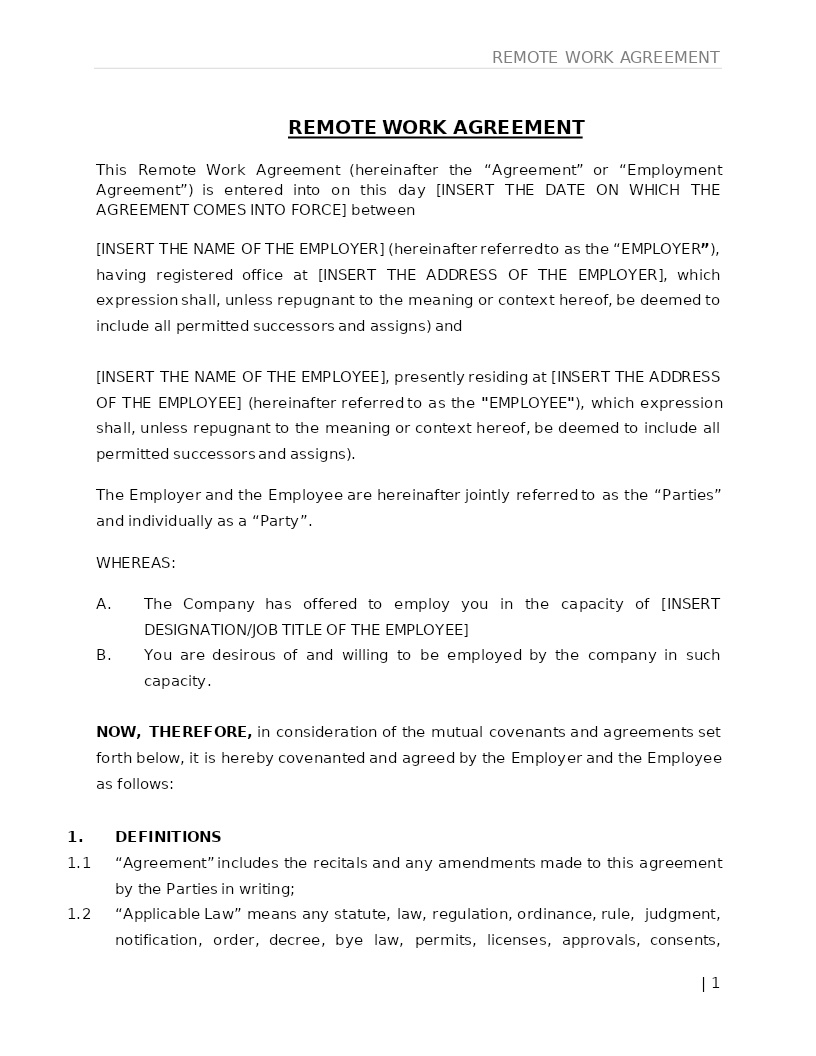
REMOTE WORK AGREEMENT
How does it work?
1. Choose this template
Start by clicking on "Fill out the template"
2. Complete the document
Answer a few questions and your document is created automatically.
3. Save - Print
Your document is ready! You will receive it in Word and PDF formats. You will be able to modify it.
Remote Work Agreement – Draft Format
“Can employees legally work from home under our employment contract?”
“Who is responsible for equipment, security, and workplace safety?”
“What happens if remote work affects productivity or confidentiality?”
“Do we need a separate agreement for remote or hybrid work?”
Employment relationships today increasingly operate beyond traditional office environments. While remote work offers flexibility and operational advantages, it also introduces legal, compliance, and management considerations that may not be addressed in standard employment documentation.
A Remote Work Agreement helps reduce uncertainty by formally documenting the terms under which an employee may perform their duties outside the employer’s physical workplace.
This Remote Work Agreement template provides a structured legal framework for defining remote working arrangements in a clear and responsible manner. It is drafted with reference to widely accepted employment law principles across multiple jurisdictions and is designed to be adapted to applicable governing law, labour regulations, and organisational policies.
It is not a substitute for legal advice in complex situations. It is intended as a practical starting point for documenting remote work arrangements.
Quick Legal Summary (At a Glance)
- Remote work agreements can form part of a legally binding employment relationship when properly documented and implemented.
- This template provides a structured framework for defining remote work terms and responsibilities.
- Enforceability depends on governing law, labour legislation, and statutory employee protections.
- Remote work arrangements generally do not alter the fundamental employer–employee relationship unless expressly stated.
- Additional legal review may be appropriate for cross-border remote work, regulated industries, or roles involving sensitive data.
This summary is provided for general informational purposes and does not constitute legal advice.
What Is a Remote Work Agreement and When Do You Need One?
A Remote Work Agreement is a formal document between an employer and an employee that defines the conditions under which the employee is permitted to work remotely, either fully or partially.
It clarifies expectations regarding work structure, communication, performance, and compliance when work is performed outside the employer’s premises.
Organizations typically adopt a Remote Work Agreement when:
- Allowing employees to work from home or other remote locations
- Implementing hybrid workplace models
- Engaging distributed or geographically remote teams
- Protecting confidential or proprietary information outside office networks
- Establishing clear expectations for communication and supervision
- Formalizing remote work policies within HR documentation
A well-structured Remote Work Agreement generally defines:
- Approved remote work location(s)
- Working hours and availability expectations
- Communication and reporting protocols
- Data security and confidentiality obligations
- Equipment and technology use
- Health and safety considerations
- Conditions for modification or termination of remote work arrangements
Clear documentation helps reduce ambiguity, maintain operational continuity, and ensure compliance with applicable employment laws.
Types of Remote Work Arrangements
Remote work may take different forms depending on organisational needs and employment structure.
This template may be adapted for several common arrangements:
1. Full-Time Remote Work: Employees perform their duties entirely from a remote location rather than an employer’s physical workplace.
2. Hybrid Work Arrangement: Employees divide their working time between remote locations and the employer’s office.
3. Temporary Remote Work: Remote work may be granted for a limited duration due to operational needs, travel, relocation, or special circumstances.
4. Cross-Border Remote Work: Employees work remotely from another jurisdiction, which may raise additional considerations relating to taxation, labour law, immigration, and regulatory compliance.
Each arrangement may require jurisdiction-specific modifications to remain enforceable and compliant with applicable laws.
Are Remote Work Agreements Legally Enforceable Internationally?
Remote Work Agreements are generally recognised within employment and contract law frameworks when properly documented and implemented.
However, enforceability depends on:
- Lawful purpose
- Clear contractual terms
- Compliance with employment legislation
- Protection of statutory employee rights
- Practical implementation consistent with labour standards
Legal treatment varies across jurisdictions. For example:
- United States: Remote employees remain subject to federal and state wage, overtime, and workplace safety requirements.
- United Kingdom & European Union: Remote work must comply with working time regulations, employment protections, and data protection laws such as GDPR.
- United Arab Emirates & Saudi Arabia: Remote arrangements operate within codified labour frameworks and employer policy requirements.
- Australia & Canada: Workplace safety obligations may extend to home work environments.
- India & Southeast Asia: Remote work arrangements operate under contract law, labour statutes, and Shops and Establishments regulations.
Courts generally assess enforceability based on clarity of documentation, fairness, and compliance with statutory protections.
No template guarantees universal enforceability.
Considerations in Remote Work Arrangements
Remote work introduces operational and legal considerations that may not arise in traditional office settings.
In some circumstances, additional provisions may be appropriate depending on organisational policies and applicable law.
- Work Hours and Availability: Clarifying expected working hours and communication practices may help maintain operational consistency.
- Data Security and Confidentiality: Remote work may increase exposure to cybersecurity and confidentiality risks, making clear protocols important.
- Equipment and Technology Use: Employers may define whether equipment is provided, reimbursed, or personally owned.
- Health and Safety Considerations: Some jurisdictions require employers to take reasonable steps to ensure safe remote working environments.
- Monitoring and Compliance: Certain roles may require clear guidelines regarding performance monitoring and information security practices.
Carefully structured documentation may help reduce misunderstandings and operational risk.
When This Remote Work Agreement Template May Not Be Sufficient
A general template may not address all legal or operational complexities.
Additional legal review may be necessary where:
- Employees work remotely across multiple jurisdictions
- Sensitive intellectual property or regulated data is involved
- Tax residency or immigration considerations arise
- Industry regulations impose additional compliance obligations
- Remote monitoring or surveillance policies are implemented
In such cases, further customization may be required to align with applicable law and organisational policies.
Common Mistakes in Remote Work Agreements
Remote work disputes frequently arise from preventable drafting or implementation issues, such as:
- Treating remote work arrangements as informal rather than documented
- Failing to define working hours or availability expectations
- Inadequate data security protocols
- Unclear equipment responsibility or expense policies
- Ignoring jurisdiction-specific labour law requirements
- Assuming remote work eliminates employer compliance obligations
Understanding these risks helps ensure responsible and effective use of remote work documentation.
Who Should Use This Remote Work Agreement Template?
This template may be useful for:
- Startups implementing remote-first work models
- Small and medium businesses formalizing remote work policies
- Companies operating hybrid workplaces
- Employers managing distributed or global teams
- HR teams standardising remote work documentation
It provides a structured starting point for documenting remote work arrangements responsibly.
How to Use This Remote Work Agreement Template Safely
Step-by-Step
- Enter the employer’s and employee’s legal details.
- Define the approved remote work location and working structure.
- Specify working hours, communication expectations, and reporting procedures.
- Address confidentiality, data protection, and technology use.
- Clarify equipment responsibility and expense policies where applicable.
- Select governing law consistent with the employment relationship.
- Review compliance with applicable labour laws and workplace policies.
- Execute the agreement through valid electronic or physical signature.
Electronic signatures are recognised in many jurisdictions, subject to applicable law and consent requirements.
Frequently Asked Questions (FAQs)
Is a Remote Work Agreement legally binding?
When properly executed as part of the employment relationship, it can form a legally binding document subject to applicable labour laws.
Does remote work change the employee’s legal status?
Not necessarily. The employee generally remains subject to the same employment terms unless specifically modified.
Can remote work arrangements be modified or revoked?
In many cases, employers may modify or discontinue remote work arrangements subject to contractual terms and applicable employment laws.
Who is responsible for workplace safety during remote work?
Legal obligations vary by jurisdiction, but employers may be expected to take reasonable steps to ensure safe working conditions.
Does a Remote Work Agreement address data protection obligations?
Such agreements commonly include confidentiality and information security requirements to protect organisational data.
Download the Remote Work Agreement Template
This Remote Work Agreement template provides a structured framework for documenting remote working arrangements clearly and responsibly.
It is intended to support clarity, operational consistency, and legal compliance when adapted to applicable employment law.
Important Notice
This template is provided as a general legal resource and does not constitute legal advice, solicitation, or advertisement within the meaning of the Bar Council of India Rules. Use of this template does not create an advocate-client relationship.
If you are preparing to discuss a business idea, commercial proposal, or funding opportunity, understanding confidentiality safeguards before disclosure is a prudent legal step.
Related Templates You May Need
- Employment Agreement
- Work From Home Policy
- Non-Disclosure Agreement (NDA)
- Intellectual Property Assignment Agreement
