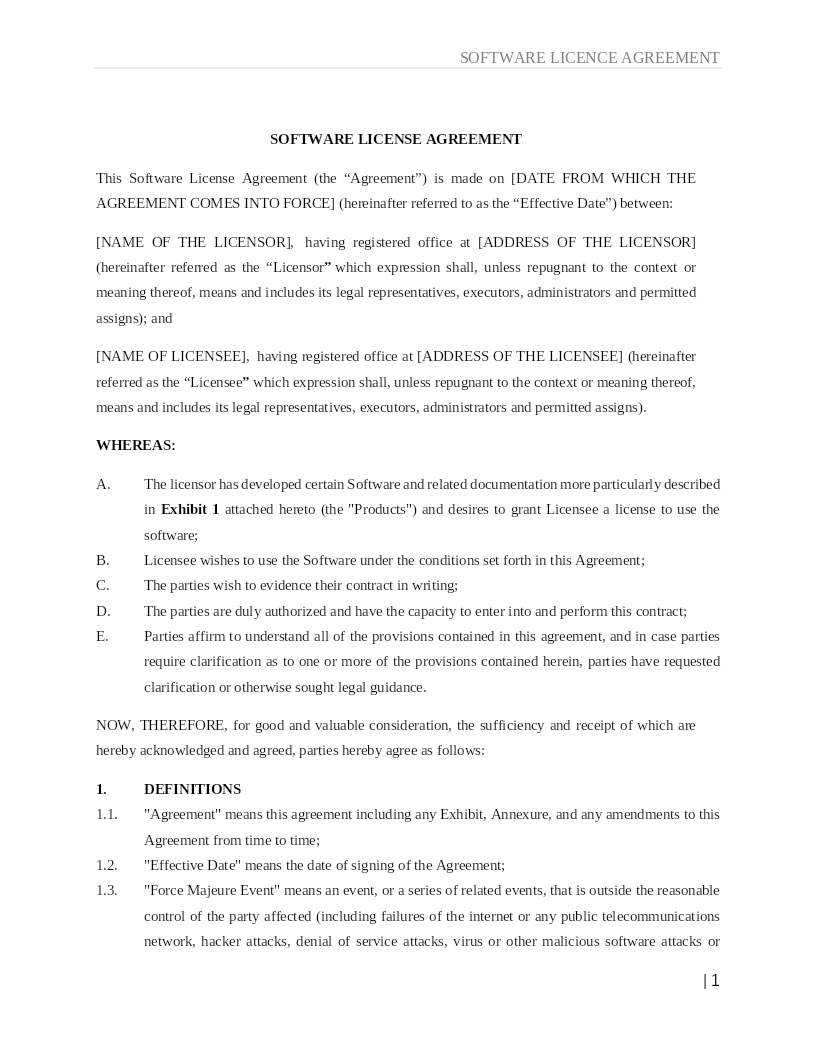
SOFTWARE LICENSE AGREEMENT
How does it work?
1. Choose this template
Start by clicking on "Fill out the template"
2. Complete the document
Answer a few questions and your document is created automatically.
3. Save - Print
Your document is ready! You will receive it in Word and PDF formats. You will be able to modify it.
Software License Agreement – Draft Format
“Is this software license actually enforceable?”
“Will this agreement protect my intellectual property?”
“Can I rely on a generic template for licensing my software?”
“What if a user misuses or copies the software?”
Software distribution often begins with trust and commercial optimism. Disputes, however, frequently arise later over licensing scope, intellectual property ownership, unauthorized copying, payment obligations, reverse engineering, or limitations that were never clearly documented.
A Software License Agreement exists to reduce that uncertainty.
This Software License Agreement template provides a structured legal framework for documenting software licensing terms clearly and responsibly. It is drafted in line with widely accepted technology law and intellectual property principles across multiple jurisdictions and is designed to be adapted to applicable governing law and regulatory requirements.
It is not a substitute for legal advice in complex technology transactions. It is intended as a practical starting point for documenting software licensing arrangements.
Quick Legal Summary (At a Glance)
- Software license agreements are legally binding when properly drafted and implemented.
- This template provides a structured framework for documenting software usage rights and restrictions.
- Enforceability depends on governing law, intellectual property regulations, and applicable contract law.
- Licensing agreements generally grant limited rights of use, not ownership of the software.
- In complex scenarios such as enterprise licensing, SaaS infrastructure, or cross-border distribution, legal review is advisable.
This summary is provided for general informational purposes and does not constitute legal advice.
What Is a Software License Agreement and When Do You Need One?
A Software License Agreement is a legally binding contract between a software owner (licensor) and a user or organization (licensee) that defines the conditions under which software may be installed, accessed, or used.
You typically need a Software License Agreement when:
- Distributing commercial software products
- Offering Software-as-a-Service (SaaS) platforms
- Licensing proprietary technology to enterprise clients
- Providing downloadable desktop or mobile applications
- Allowing third parties to integrate with your software or APIs
- Protecting source code and proprietary algorithms
A well-structured software license agreement generally defines:
- Scope of the software license
- Permitted and prohibited uses
- Intellectual property ownership
- License duration and termination rights
- Payment or subscription terms
- Maintenance, updates, and support obligations
- Confidentiality and data protection provisions
- Liability limitations and dispute resolution mechanisms
Clear documentation helps reduce misunderstandings, manage intellectual property risk, and establish predictable commercial expectations.
Types of Software Licensing Structures
This template can be adapted for different licensing models, depending on the software product and business model.
1. Perpetual License: Provides indefinite rights to use the software, typically following a one-time purchase, subject to the agreement’s restrictions.
2. Subscription License (SaaS): Allows access to software for a defined period, often through cloud-based infrastructure with recurring payments.
3. User-Based or Seat License: Limits software use to a specified number of users, accounts, or installations.
4. Enterprise License: Permits broader organizational use, typically negotiated for larger clients or corporate environments.
Each licensing model may require modifications depending on jurisdiction, regulatory requirements, and distribution methods.
Are Software License Agreements Legally Enforceable Internationally?
Software licensing agreements are widely recognized under intellectual property and contract law frameworks. However, enforceability depends on factors such as:
- Lawful purpose and clarity of terms
- Compliance with copyright and intellectual property laws
- Valid acceptance of licensing terms
- Compliance with consumer protection or technology regulations
Legal treatment may differ across jurisdictions. For example:
- United States: Software licenses are governed by contract law, copyright law, and statutes such as the Uniform Commercial Code.
- European Union & United Kingdom: Strong consumer protection and digital service regulations apply.
- United Arab Emirates & Singapore: Technology licensing must comply with commercial and electronic transaction laws.
- India: Software licensing is primarily governed by the Indian Contract Act, 1872 and the Copyright Act, 1957.
Courts generally evaluate software license agreements based on clarity, fairness, and lawful intellectual property protection. No template guarantees universal enforceability.
Considerations in Complex Software Licensing Arrangements
Generic templates frequently omit important structural safeguards relevant to software licensing.
Depending on the product and business model, additional provisions may be required.
License Scope Definition: Clearly defines permitted installations, users, or integrations to prevent unauthorized usage.
Intellectual Property Protection: Protects proprietary source code, algorithms, documentation, and software architecture.
Restrictions on Reverse Engineering: Helps prevent copying, decompiling, or unauthorized modification of software.
Update and Maintenance Framework: Defines whether updates, patches, or version upgrades are included within the license.
Security and Data Protection: Addresses obligations relating to personal data, system security, and regulatory compliance.
Clear drafting can significantly reduce ambiguity in software distribution and licensing relationships.
When This Software License Agreement Template May Not Be Sufficient
A template may not be adequate if:
- Software involves regulated industries (finance, healthcare, or telecommunications)
- The software includes complex SaaS infrastructure or multi-tenant architecture
- Licensing involves cross-border intellectual property transfers
- The agreement includes source code escrow arrangements
- Significant enterprise licensing or reseller distribution is involved
In such circumstances, legal review and customization may be necessary.
Common Mistakes in Software License Agreements
Many disputes arise from avoidable drafting or implementation errors, such as:
- Failing to clearly define licensing scope
- Omitting restrictions on copying or reverse engineering
- Using inconsistent terms across different software products
- Ignoring applicable consumer or data protection laws
- Failing to address update, maintenance, or support obligations
- Assuming software ownership transfers to the user
Understanding these risks can help ensure responsible use of licensing documentation.
Who Should Use This Software License Agreement Template?
This template is commonly used by:
- Software developers and technology companies
- SaaS startups distributing cloud applications
- Enterprises licensing proprietary software systems
- Technology consultants delivering custom software solutions
- Businesses distributing downloadable or subscription-based software
It provides a structured starting point for documenting software licensing arrangements in a responsible and transparent manner.
How to Use This Software License Agreement Template Safely
Step-by-Step
- Enter the licensor and licensee’s legal details.
- Define the software product and scope of the license.
- Specify licensing model (perpetual, subscription, or user-based).
- Include intellectual property and confidentiality protections.
- Define payment terms, if applicable.
- Select governing law consistent with the relevant jurisdiction.
- Execute the agreement through valid electronic or physical signature.
Electronic signatures are recognized in many jurisdictions, subject to applicable law and consent requirements.
Frequently Asked Questions (FAQs)
Is this Software License Agreement valid internationally?
It provides a general licensing structure that can be adapted across jurisdictions. Enforceability depends on compliance with local intellectual property and contract laws.
Does this agreement transfer ownership of the software?
No. Software license agreements generally grant limited usage rights while ownership remains with the licensor.
Can this template be used for SaaS platforms?
Yes, but SaaS deployments may require additional provisions related to hosting, uptime, service levels, and data processing.
Does this template prevent reverse engineering?
The agreement typically includes restrictions on copying, decompiling, or modifying the software, subject to applicable law.
Is a free template sufficient for all software businesses?
Not always. Complexity increases with enterprise licensing, cross-border distribution, API integrations, or regulatory oversight.
Download the Software License Agreement Template
This Software License Agreement template provides a structured framework for documenting software licensing terms in a legally responsible manner.
It is designed to promote clarity, reduce misunderstandings, and support compliance when adapted to applicable law.
Important Notice
This template is provided as a general legal resource and does not constitute legal advice, solicitation, or advertisement within the meaning of the Bar Council of India Rules. Use of this template does not create an advocate-client relationship.
Related Templates You May Need
- End User License Agreement (EULA)
- SaaS Agreement
- Software Development Agreement
- Non-Disclosure Agreement (NDA)
