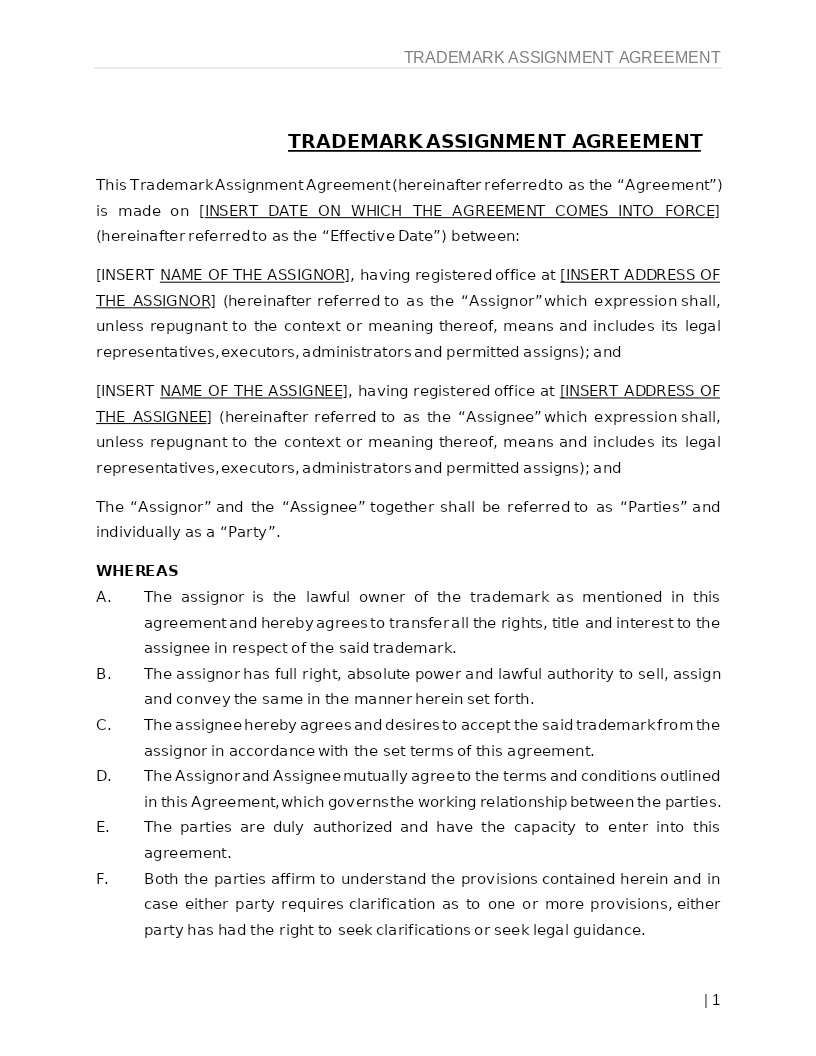
TRADEMARK ASSIGNMENT AGREEMENT
How does it work?
1. Choose this template
Start by clicking on "Fill out the template"
2. Complete the document
Answer a few questions and your document is created automatically.
3. Save - Print
Your document is ready! You will receive it in Word and PDF formats. You will be able to modify it.
Trademark Assignment Agreement – Draft Format
“Can a trademark really be transferred legally?”
“What happens if the goodwill of the brand is not transferred?”
“Is recording the assignment mandatory?”
“Will the transfer remain valid across jurisdictions?”
Trademark ownership is often treated as a business asset similar to property. However, disputes commonly arise later regarding ownership chains, validity of the transfer, goodwill associated with the mark, or recordal requirements with trademark registries.
A Trademark Assignment Agreement exists to reduce that uncertainty.
This Trademark Assignment Agreement template provides a structured legal framework for documenting the transfer of ownership of a trademark from one party to another. It reflects generally accepted intellectual property law principles across multiple jurisdictions and is designed to be adapted to the governing law applicable to the parties.
It is not a substitute for legal advice in complex transactions. It is intended as a structured starting point.
Quick Legal Summary (At a Glance)
- Trademark assignments are legally recognised transfers of ownership when properly documented.
- The agreement typically transfers rights, title, and interest in a trademark, often together with associated goodwill.
- Enforceability depends on compliance with applicable trademark statutes, registry procedures, and governing law.
- Many jurisdictions require written agreements and recordal with the national trademark office.
- Certain assignments may be restricted if they mislead consumers or create conflicting ownership rights.
- For cross-border transfers, mergers, acquisitions, or trademark portfolios, professional legal review may be advisable.
This summary is provided for general informational purposes and does not constitute legal advice.
What Is a Trademark Assignment Agreement and When Do You Need One?
A Trademark Assignment Agreement is a legally binding contract through which one party (the Assignor) transfers ownership of a trademark to another party (the Assignee).
Unlike a trademark licence, which merely permits use of a mark, an assignment permanently transfers ownership rights, including the ability to use, enforce, and commercially exploit the trademark.
A formal trademark assignment agreement may be required when:
- A business sells a brand or product line
- A company transfers intellectual property during mergers or acquisitions
- A startup transfers brand ownership to investors or acquiring entities
- Intellectual property ownership is reorganised within a corporate group
- Designers, agencies, or creators transfer trademark rights to clients
- Businesses consolidate trademark ownership for licensing or franchising
A well-structured trademark assignment agreement generally defines:
- The trademark being transferred
- Whether goodwill associated with the mark is included
- Scope of rights assigned
- Representations and warranties regarding ownership
- Effective date of transfer
- Governing law and dispute resolution
- Obligations regarding recordal with trademark authorities
Clear documentation helps maintain a transparent chain of title, which is essential for enforcement and regulatory compliance.
Types of Trademark Assignments
This template may be adapted for several types of trademark transfers, subject to jurisdiction-specific intellectual property laws.
1. Full Assignment: Transfers complete ownership of a trademark together with associated goodwill and rights across all registered goods or services.
2. Partial Assignment: Transfers ownership only for specific goods or services within a trademark registration.
3. Assignment with Goodwill: The most commonly recognised form of assignment, where the trademark is transferred together with the commercial reputation and consumer recognition associated with the mark.
4. Assignment Between Related Entities: Common in corporate restructurings where trademarks are transferred between parent companies, subsidiaries, or affiliated entities.
Different jurisdictions may impose additional procedural requirements for each type of assignment.
Are Trademark Assignments Legally Enforceable Internationally?
Trademark assignments are widely recognised under intellectual property law frameworks. However, enforceability depends on:
- Lawful ownership of the trademark
- Valid written documentation
- Transfer of goodwill where required
- Compliance with trademark registry procedures
- Proper recordal with national IP authorities
Trademark assignment laws vary across jurisdictions. For example:
- United States: Governed by the Lanham Act, requiring written assignments and transfer of goodwill to maintain validity.
- United Kingdom & European Union: Assignments are recognised under trademark legislation and must typically be recorded with the relevant intellectual property offices.
- United Arab Emirates & Saudi Arabia: Assignments must comply with statutory trademark regulations and may require notarisation and official recordal.
- India: Governed by the Trade Marks Act, 1999, which permits assignment with or without goodwill subject to certain statutory restrictions.
- Australia & Canada: Assignments are recognised under national trademark statutes and should be recorded to maintain a clear ownership chain.
Courts generally evaluate trademark assignments based on legality, clarity, consumer protection considerations, and compliance with statutory procedures.
No template guarantees universal enforceability.
Considerations in Trademark Assignments
Generic online templates often omit structural safeguards necessary for intellectual property transfers.
In more complex transactions, additional provisions may be required depending on legal and commercial context.
Clear Identification of the Trademark: Registration numbers, application details, and jurisdictions should be clearly specified.
Goodwill Transfer: Failure to transfer goodwill in jurisdictions where it is required may invalidate the assignment.
Representations and Warranties: The assignor should typically confirm lawful ownership and absence of undisclosed disputes.
Recordal Requirements: Many jurisdictions require assignment recordal with the national trademark registry to establish public notice.
Jurisdiction and Governing Law: Cross-border trademark transfers require careful consideration of applicable legal systems.
Clear documentation can help reduce ambiguity and maintain enforceability.
When This Trademark Assignment Template May Not Be Sufficient
A template may not be adequate where:
- Multiple jurisdictions or international registrations are involved
- The trademark portfolio spans multiple countries
- The transfer occurs as part of a merger or acquisition
- The trademark is subject to existing licences or security interests
- Tax or valuation implications are significant
- Consumer protection or competition law concerns arise
In such cases, the agreement may require substantial modification to align with applicable law and commercial arrangements.
Common Mistakes in Trademark Assignment Agreements
Many intellectual property disputes arise from preventable drafting or implementation issues, including:
- Failing to transfer goodwill where required
- Omitting trademark registration numbers
- Assigning rights that the assignor does not legally own
- Not recording the assignment with the relevant trademark office
- Creating conflicting ownership rights across jurisdictions
- Using inconsistent descriptions of the trademark
- Copying clauses from unrelated agreements
Understanding these risks helps support responsible intellectual property management.
Who Should Use This Trademark Assignment Template?
This template is commonly used by:
- Businesses transferring ownership of a brand or trademark portfolio
- Companies undergoing mergers, acquisitions, or restructuring
- Startups transferring brand rights to acquiring entities
- Designers, agencies, or creators assigning brand names or logos to clients
- Businesses consolidating trademarks within corporate groups
- Organisations acquiring dormant or legacy brands
It provides a structured starting point for documenting trademark transfers responsibly.
How to Use This Trademark Assignment Template Safely
Step-by-Step
- Enter the full legal details of the assignor and assignee.
- Identify the trademark being assigned, including registration numbers and jurisdictions.
- Confirm whether goodwill associated with the trademark is included.
- Define representations and warranties regarding ownership and validity.
- Specify the governing law applicable to the agreement.
- Review statutory requirements under applicable trademark law.
- Record the assignment with the relevant trademark office where required.
- Execute the agreement through valid electronic or physical signatures.
Electronic signatures are recognised in many jurisdictions subject to applicable law and consent requirements.
Frequently Asked Questions (FAQs)
Is this Trademark Assignment Agreement valid internationally?
It provides a general framework that can be adapted across jurisdictions. Enforceability depends on compliance with local trademark laws and registry procedures.
Can a trademark be assigned without goodwill?
Some jurisdictions allow this, but others may treat such assignments as invalid or problematic if they mislead consumers.
Is recordal with the trademark registry mandatory?
Many jurisdictions require or strongly recommend recording the assignment to establish public notice and maintain a clear chain of title.
Can this agreement be used for multiple trademarks?
Yes, provided each trademark is clearly identified and described.
Are electronic signatures valid for trademark assignments?
Electronic signatures are recognised in many jurisdictions, including under the Information Technology Act, 2000 in India, subject to applicable legal requirements.
Download the Trademark Assignment Agreement Template
This Trademark Assignment Agreement template provides a structured framework for documenting the transfer of trademark ownership in a legally responsible manner.
It is intended to support clarity, reduce uncertainty regarding ownership rights, and assist in maintaining a transparent chain of title when properly adapted to applicable law.
Important Notice
This template is provided as a general legal resource and does not constitute legal advice, solicitation, or advertisement within the meaning of the Bar Council of India Rules.
Use of this template does not create an advocate-client relationship.
Where intellectual property rights form a significant commercial asset, obtaining professional legal advice before executing an assignment may assist in ensuring compliance with applicable laws and regulatory procedures.
Related Templates You May Need\
- Non-Disclosure Agreement (NDA)
- Intellectual Property Assignment Agreement
- Trademark License Agreement
- Brand Purchase Agreement
