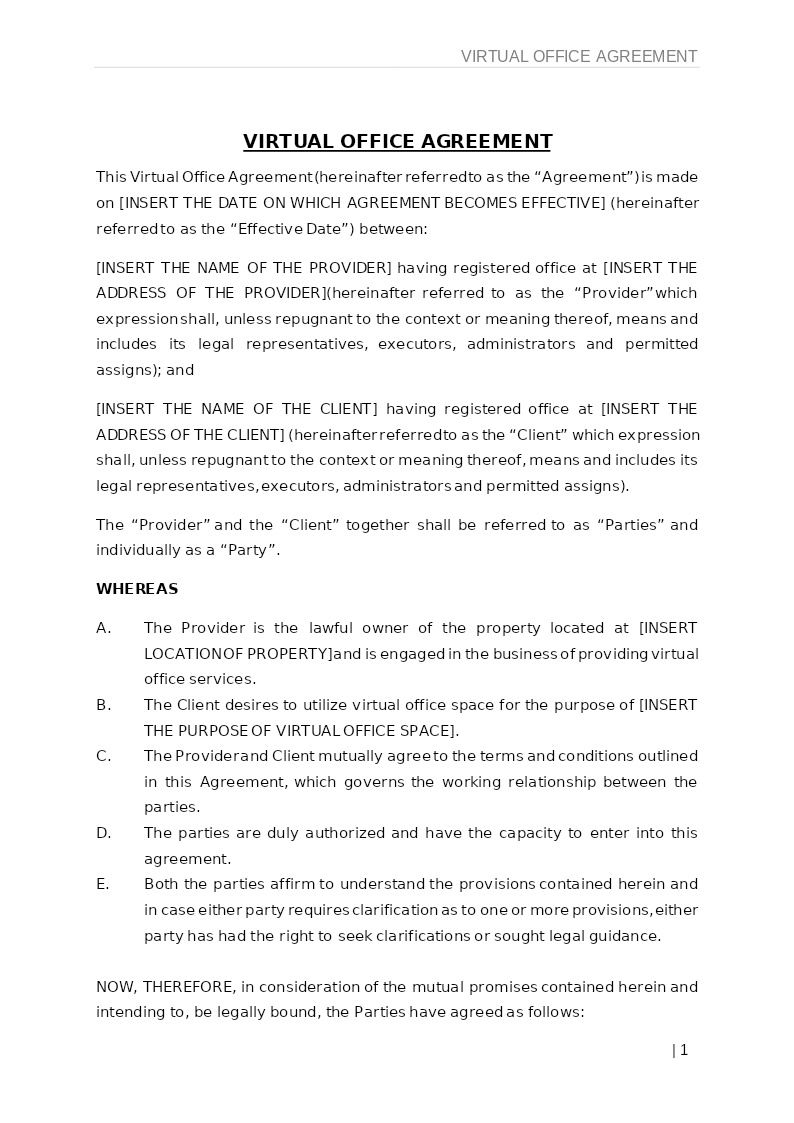
VIRTUAL OFFICE AGREEMENT
How does it work?
1. Choose this template
Start by clicking on "Fill out the template"
2. Complete the document
Answer a few questions and your document is created automatically.
3. Save - Print
Your document is ready! You will receive it in Word and PDF formats. You will be able to modify it.
Virtual Office Agreement – Draft Format
“Is using a virtual office address legally acceptable for my business?”
“Will this agreement protect the service provider and the client if regulatory issues arise?”
“Can a virtual office address be used safely for company registration or GST purposes?”
“What happens if the address is misused or regulatory authorities question the arrangement?”
Businesses increasingly operate remotely, across jurisdictions, or without a permanent physical office. While virtual office services provide operational flexibility, regulatory and compliance concerns can arise if the arrangement is not properly documented.
A Virtual Office Agreement exists to reduce that uncertainty.
This Virtual Office Agreement template provides a structured legal framework for documenting the terms under which virtual office services are provided, including registered address usage, administrative services, regulatory responsibilities, and limitations on physical occupancy.
It is drafted in line with commonly accepted commercial contract principles and is designed to be adapted to applicable governing law and regulatory requirements.
It is not a substitute for legal advice in complex regulatory or licensing situations. It is intended as a practical starting point for documenting virtual office arrangements responsibly.
Quick Legal Summary (At a Glance)
• Virtual Office Agreements are generally enforceable when drafted as valid commercial contracts.
• The agreement defines the scope of services such as registered address use, mail handling, and administrative support.
• The arrangement does not create tenancy or physical possession rights unless expressly stated.
• Regulatory acceptance of a virtual office address depends on the relevant authority (company registry, tax authority, licensing body).
• Misrepresentation of business presence or misuse of the address may expose parties to compliance risks.
• Legal review may be advisable when the virtual office is used for regulated activities, licensing, or cross-border operations.
This summary is provided for general informational purposes and does not constitute legal advice.
What Is a Virtual Office Agreement and When Do You Need One?
A Virtual Office Agreement is a legally binding contract between a service provider and a business client that defines the terms under which virtual office services are made available.
These services typically include:
• Use of a registered business address
• Mail receiving and forwarding services
• Call handling or administrative support
• Access to meeting rooms or shared workspace (where available)
• Limited representation of business presence at the address
A formal Virtual Office Agreement is commonly used when:
• A business requires a registered office address without maintaining physical premises
• Startups or entrepreneurs operate remotely or digitally
• Foreign companies establish local administrative presence
• Businesses require mail handling or correspondence management
• Companies seek a professional business address for regulatory filings
A well-structured agreement typically clarifies:
• Permitted use of the business address
• Scope and limitations of services
• Compliance obligations of the client
• Restrictions on misleading representation
• Duration of the arrangement
• Termination and suspension rights
• Liability limitations and regulatory safeguards
Clear documentation helps reduce regulatory confusion and ensures both parties understand the boundaries of the arrangement.
Types of Virtual Office Arrangements
Virtual office services may vary depending on operational and regulatory needs.
1. Registered Address Services: A business may use the address for official correspondence, company registration, or statutory filings where permitted by applicable regulations.
2. Mail Handling Services: The provider receives and forwards correspondence addressed to the client business.
3. Administrative Support Services: Some arrangements include call answering, receptionist services, or document handling.
4. Meeting Room or Workspace Access: Certain providers allow limited access to meeting rooms or shared office facilities, subject to availability and prior booking.
Each type of arrangement may require additional regulatory or contractual safeguards depending on the jurisdiction.\
Are Virtual Office Agreements Legally Recognised Internationally?
Virtual office arrangements are commonly recognised under commercial contract law, provided they do not misrepresent the nature of business operations.
However, enforceability and regulatory acceptance depend on:
• Lawful contractual purpose
• Accurate disclosure of services
• Compliance with business registration requirements
• Proper documentation of address usage
Regulatory treatment varies across jurisdictions.
For example:
India: Virtual office addresses are sometimes used for company incorporation and GST registration, subject to documentation requirements and regulatory acceptance.
United States: Virtual offices are commonly used for administrative services and business addresses, though regulatory disclosures may apply.
United Kingdom & European Union: Registered office addresses may be provided by service providers subject to corporate compliance rules.
United Arab Emirates: Virtual office services may operate under licensing frameworks, particularly in free zones.
Australia & Canada: Virtual office arrangements are generally permitted where the address is not used in a misleading manner.
Authorities may examine whether the address accurately reflects the nature of the business presence.
No template can guarantee universal regulatory acceptance.
Considerations in Virtual Office Arrangements
Generic templates often overlook regulatory and operational safeguards required in virtual office arrangements.
Depending on the business context, agreements may require provisions addressing the following:
Permitted Address Usage: Clear limitations reduce the risk of regulatory misuse or misrepresentation.
Compliance Responsibilities: The client business remains responsible for complying with licensing, tax, and regulatory obligations.
Identity Verification and Documentation: Service providers may require verification documents to comply with regulatory requirements or internal compliance policies.
Mail Handling Procedures: Clear procedures reduce the risk of lost correspondence or disputes over delivery.
Suspension or Termination Rights: Service providers may require the ability to suspend services where misuse, regulatory concerns, or legal violations occur.
Structured documentation helps manage compliance risks for both parties.
When This Virtual Office Agreement Template May Not Be Sufficient
A standard template may require modification where:
• The address is used for regulated business activities
• Licensing or regulatory approval is required
• The arrangement involves multiple jurisdictions
• The client operates in a high-compliance industry
• Cross-border tax or corporate structuring issues arise
In such cases, jurisdiction-specific legal review may be necessary.
Common Mistakes in Virtual Office Agreements
Many disputes or regulatory issues arise from avoidable drafting or implementation problems, including:
• Using a virtual office address without verifying regulatory acceptance
• Allowing unrestricted use of the address in marketing or filings
• Failing to define service scope clearly
• Not addressing misuse or unlawful activities
• Confusing a virtual office arrangement with tenancy or lease rights
• Copying clauses from unrelated service agreements
Understanding these risks helps ensure responsible use of virtual office arrangements.
Who Should Use This Virtual Office Agreement Template?
This template may be relevant for:
• Startups operating without physical office premises
• Remote or digital-first businesses
• Entrepreneurs establishing a formal business address
• Foreign companies seeking administrative presence
• Service providers offering virtual office solutions
It serves as a structured starting point for documenting virtual office services responsibly.
How to Use This Virtual Office Agreement Template Safely
Step-by-Step
- Enter the service provider’s legal details and address information.
- Identify the client business and authorised representatives.
- Define the permitted use of the virtual office address.
- Specify services such as mail handling or administrative support.
- Include limitations on physical access or occupancy rights.
- Select governing law consistent with the applicable jurisdiction.
- Execute the agreement through valid electronic or physical signature.
Electronic signatures are generally recognised in many jurisdictions, subject to applicable law and mutual consent.
Frequently Asked Questions (FAQs)
Is a Virtual Office Agreement legally valid?
Yes. When properly drafted and executed, it is generally enforceable as a commercial service contract.
Does a virtual office provide physical possession of the premises?
No. It typically grants limited administrative or address usage rights, not tenancy or lease rights.
Can a virtual office address be used for company registration?
In some jurisdictions, yes. However, acceptance depends on regulatory requirements and documentation.
Who is responsible for regulatory compliance?
The client business generally remains responsible for complying with licensing, tax, and regulatory obligations.
Can the service provider terminate the arrangement?
Most agreements allow termination or suspension where misuse, non-payment, or regulatory concerns arise.
Download the Virtual Office Agreement Template
This Virtual Office Agreement template provides a structured framework for documenting virtual office services in a legally responsible manner.
It is designed to promote clarity, reduce regulatory uncertainty, and support proper documentation of address usage when adapted to applicable law.
Important Notice
This template is provided as a general legal resource and does not constitute legal advice, solicitation, or advertisement within the meaning of the Bar Council of India Rules. Use of this template does not create an advocate-client relationship.
Parties should consider reviewing the agreement in light of applicable regulatory, licensing, and compliance requirements before implementation.
