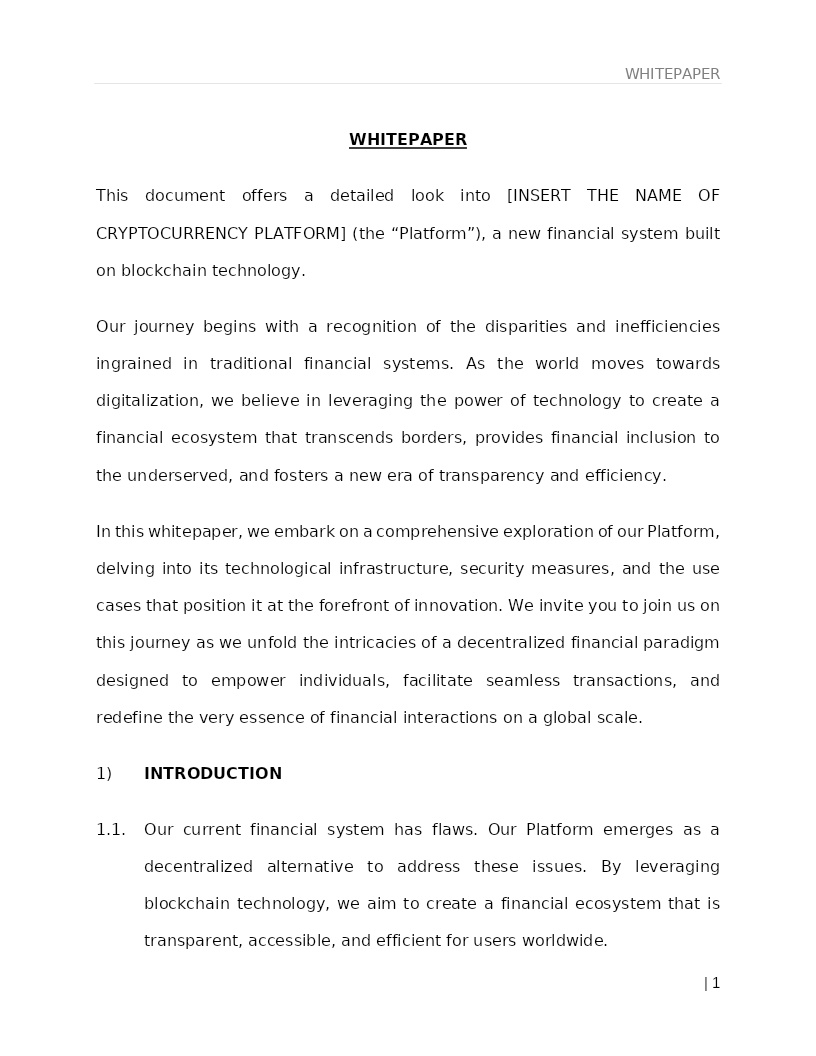
WHITEPAPER
How does it work?
1. Choose this template
Start by clicking on "Fill out the template"
2. Complete the document
Answer a few questions and your document is created automatically.
3. Save - Print
Your document is ready! You will receive it in Word and PDF formats. You will be able to modify it.
Whitepaper – Draft Format
“Is this whitepaper credible enough for investors or stakeholders?”
“Will the document clearly explain the technology or business model?”
“Can a template structure help organise complex information properly?”
“What if the explanation lacks clarity or technical depth?”
Whitepapers are often prepared when organisations need to explain a technology, system, policy framework, or commercial concept in a structured and authoritative manner. However, unclear explanations, unsupported claims, or poorly structured documentation can reduce credibility and create misunderstandings among readers.
A well-structured whitepaper exists to provide clarity.
This Whitepaper template offers a structured framework for presenting complex ideas, technologies, business models, or research insights in a clear and organised format. It is designed to support responsible documentation of technical, commercial, or analytical information that may be shared with stakeholders, partners, investors, or the public.
The template is intended as a practical drafting starting point. It may require modification depending on the industry, regulatory environment, and purpose of the document.
Quick Legal Summary (At a Glance)
• A whitepaper is primarily an informational or analytical document.
• It explains a technology, product, research finding, or business model in a structured format.
• Whitepapers may support investor discussions, product launches, research publication, or industry analysis.
• The document itself generally does not create legally binding obligations unless expressly incorporated into contractual arrangements.
• Accuracy, transparency, and appropriate disclaimers are important when discussing financial, technical, or investment-related information.
This summary is provided for general informational purposes and does not constitute legal advice.
What Is a Whitepaper and When Do You Need One?
A Whitepaper is a structured document that explains a product, technology, research concept, or business strategy in detail. It typically combines background context, problem analysis, and a proposed solution within a clear narrative supported by data, technical explanations, or market insights.
Organisations commonly prepare a whitepaper when they need to:
• Present a technological architecture or innovation
• Explain a product or platform in depth
• Communicate research findings or industry analysis
• Provide context for a digital project or protocol
• Inform potential partners, investors, or stakeholders
• Clarify complex ideas that require more explanation than a marketing document
A well-structured whitepaper typically includes:
• Background context and problem definition
• Description of the proposed solution or concept
• Technical or operational framework
• Market relevance or use cases
• Implementation or development roadmap
• Risk disclosures or limitations where relevant
Clear documentation helps readers understand complex concepts and evaluate the proposed solution or research objectively.
Types of Whitepapers
This template can be adapted for several types of whitepapers depending on the purpose of the document.
- Technical Whitepaper: Explains system architecture, software infrastructure, algorithms, protocols, or engineering design.
- Product Whitepaper: Describes product features, operational mechanisms, and practical use cases for potential users or partners.
- Business Strategy Whitepaper: Outlines a business model, strategic framework, or market opportunity.
- Industry Research Whitepaper: Presents data analysis, policy evaluation, or industry trends supported by research.
- Blockchain or Protocol Whitepaper: Commonly used to explain decentralised systems, token mechanisms, consensus models, or digital infrastructure.
Each type may require adjustments to structure, level of technical detail, and supporting evidence.
Are Whitepapers Recognised Internationally?
Whitepapers are widely used across industries as informational or analytical documents. Their acceptance and use vary depending on the sector.
For example:
United States: Whitepapers are frequently used in technology sectors, research publication, and B2B communications.
United Kingdom and European Union: Whitepapers are often used for regulatory analysis, policy discussions, and industry research.
United Arab Emirates and Saudi Arabia: Technology and financial sectors commonly use whitepapers to explain digital platforms or investment frameworks.
Australia and Canada: Whitepapers are used for academic, policy, and business research purposes.
India and Asia-Pacific markets: Whitepapers are commonly used in technology, fintech, SaaS, and research communication.
While widely accepted as informational documents, whitepapers are generally not legally binding instruments unless incorporated into contractual arrangements or regulatory filings.
Considerations in Complex Whitepaper Projects
Generic templates may not address the level of detail required for specialised industries or advanced technical systems.
In more complex contexts, additional considerations may include:
- Technical Accuracy: Technical descriptions should be supported by credible data, diagrams, or research sources.
- Clarity of Explanation: Complex systems should be explained in a way that allows non-technical readers to understand the core concept.
- Evidence and References: Claims relating to performance, market opportunity, or technology capabilities should be supported by evidence where possible.
- Risk and Limitation Disclosure: Where relevant, the document should acknowledge uncertainties, limitations, or assumptions.
- Regulatory Context: Industries such as finance, healthcare, or digital assets may require careful compliance considerations.
Clear structure and transparent communication support responsible use of whitepapers in professional environments.
When This Whitepaper Template May Not Be Sufficient
A standard template may require further modification when:
• The document involves regulated financial or investment products
• Complex engineering or scientific research is being presented
• Cross-border regulatory considerations apply
• Token issuance, digital asset frameworks, or financial mechanisms are involved
• Independent technical verification is necessary
In such situations, specialised technical, financial, or regulatory review may be appropriate.
Common Mistakes in Whitepapers
Whitepapers sometimes lose credibility due to avoidable drafting issues such as:
• Overly promotional or marketing-focused language
• Lack of technical clarity or supporting data
• Unsupported claims regarding performance or market potential
• Poorly structured explanations
• Missing disclaimers or contextual limitations
• Inconsistent terminology throughout the document
Careful drafting and structured presentation improve readability and reliability.
Who Should Use This Whitepaper Template?
This template may be useful for:
• Startups explaining a product or technological solution
• Companies presenting industry research or market analysis
• Organisations documenting technical architecture or system design
• Research teams preparing analytical publications
• Businesses describing operational frameworks or digital platforms
The template serves as a structured starting point for presenting information in a clear and organised manner.
How to Use This Whitepaper Template Safely
Step-by-Step
- Define the purpose and intended audience of the whitepaper.
- Clearly explain the problem, context, or research objective.
- Describe the proposed solution, system, or analysis in structured sections.
- Include technical explanations, diagrams, or supporting data where relevant.
- Ensure that claims are accurate and appropriately supported.
- Add contextual disclaimers where the document discusses projections, financial models, or technological capabilities.
- Publish the document in a format suitable for digital or print distribution.
Maintaining clarity and transparency improves reader understanding and credibility.
Frequently Asked Questions (FAQs)
Is a whitepaper a legally binding document?
Generally, no. A whitepaper is primarily informational unless incorporated into legally binding agreements.
Can a whitepaper be used for investor discussions?
Yes. Whitepapers often provide detailed explanations of technologies, business models, or research findings that may support investor discussions.
Is a whitepaper the same as a business plan?
No. A business plan focuses on operational and financial planning, while a whitepaper typically explains a concept, technology, or research framework.
Can a whitepaper include diagrams or technical architecture?
Yes. Diagrams, charts, and technical explanations are commonly included to improve understanding.
Can multiple authors contribute to a whitepaper?
Yes. Contributors, researchers, or advisors are often acknowledged in the document.
Can the document be updated later?
Yes. Many whitepapers include version numbers and revision history to reflect updates.
Download the Whitepaper Template
This Whitepaper template provides a structured framework for explaining technologies, research concepts, or business models in a clear and organised format.
It is designed to assist organisations in presenting complex ideas responsibly while maintaining clarity and transparency.
Important Notice
This template is provided as a general informational resource and does not constitute legal advice, solicitation, or advertisement within the meaning of the Bar Council of India Rules.
Use of this template does not create an advocate–client relationship.
Users should ensure that the final document is accurate and appropriate for the intended audience and jurisdiction.
Related Templates You May Need
• Non-Disclosure Agreement (NDA)
• Technical Specification Document
• Business Plan
• Intellectual Property Assignment Agreement
